
Investment and Financial Fraud in Türkiye: Types, Signs, Recovery
Investment and financial fraud is the general name for acts aimed at obtaining a person's money by deceit under the appearance of an "investment". The headline changes: forex, stock market, crypto assets, gold, commodities or a "private fund". The only thing that does not change is the outcome: the money paid in is not returned. In recent years in Türkiye these schemes have spread widely through social media ads, WhatsApp and Telegram groups, fake mobile apps and the unauthorised use of well-known institutions' names.
This guide covers the subject from start to finish: the definition and legal nature of the fraud, its most common types, a step-by-step outline of how it works, the psychological techniques used, warning signs, how to verify whether an institution is authorised, the legal routes that come into play for getting money back, the traceability of crypto transactions, and the risk of being targeted a second time after a loss.
- What Is Investment and Financial Fraud?
- The Most Common Types of Fraud
- The 7 Stages of the Fraud
- Psychological Manipulation Techniques Used
- Danger Signals: Warning Signs
- Is an Institution Authorised? Verification Steps
- Legal Framework: Which Offences Come into Play?
- Solution: Routes Available for Getting Money Back
- The Position in Crypto-Related Losses
- The Second Trap: Loss Recovery Fraud
- The Position of Those Who Let Their Account Be Used (IBAN Renting)
- Common Mistakes After a Loss
- Prevention: Pre-Investment Checklist
- Frequently Asked Questions
⚖️ What Is Investment and Financial Fraud?
In the legal sense, fraud is a person being deceived by deceitful conduct, so that an unjust benefit is obtained for the perpetrator or another person, to the detriment of the victim or someone else. In its investment form, this deceit usually consists of a combination of three elements:
- A corporate appearance: A professional website, a brand with trust-evoking words such as "securities", "capital", "invest" or "portfolio", and fake licence and award images.
- An unrealistic promise of profit: A short-term return that cannot be explained by market conditions and is often described as "certain" or "risk-free".
- A screen controlled by the other side: A system in which the balance and profit are written not to a real market transaction but to a panel run entirely by the fraudster.
When these three come together, the "profit" the victim sees is in reality nothing more than a screen image. When a withdrawal request is made, it emerges that the system holds no assets at all, and the process turns into new payment demands or silence.
Is trading on an illegal platform a crime?
No. A person who invests on an unauthorised platform does not commit a crime; they are a victim. In practice, victims are often frightened with lines such as "you did something illegal too, you will get into trouble". This rhetoric is a pressure tool used to prevent the person from seeking their rights and has no legal basis.
🧩 The Most Common Types of Fraud
Although the methods differ on the surface, the logic is the same. The forms most often encountered in Türkiye are listed below:
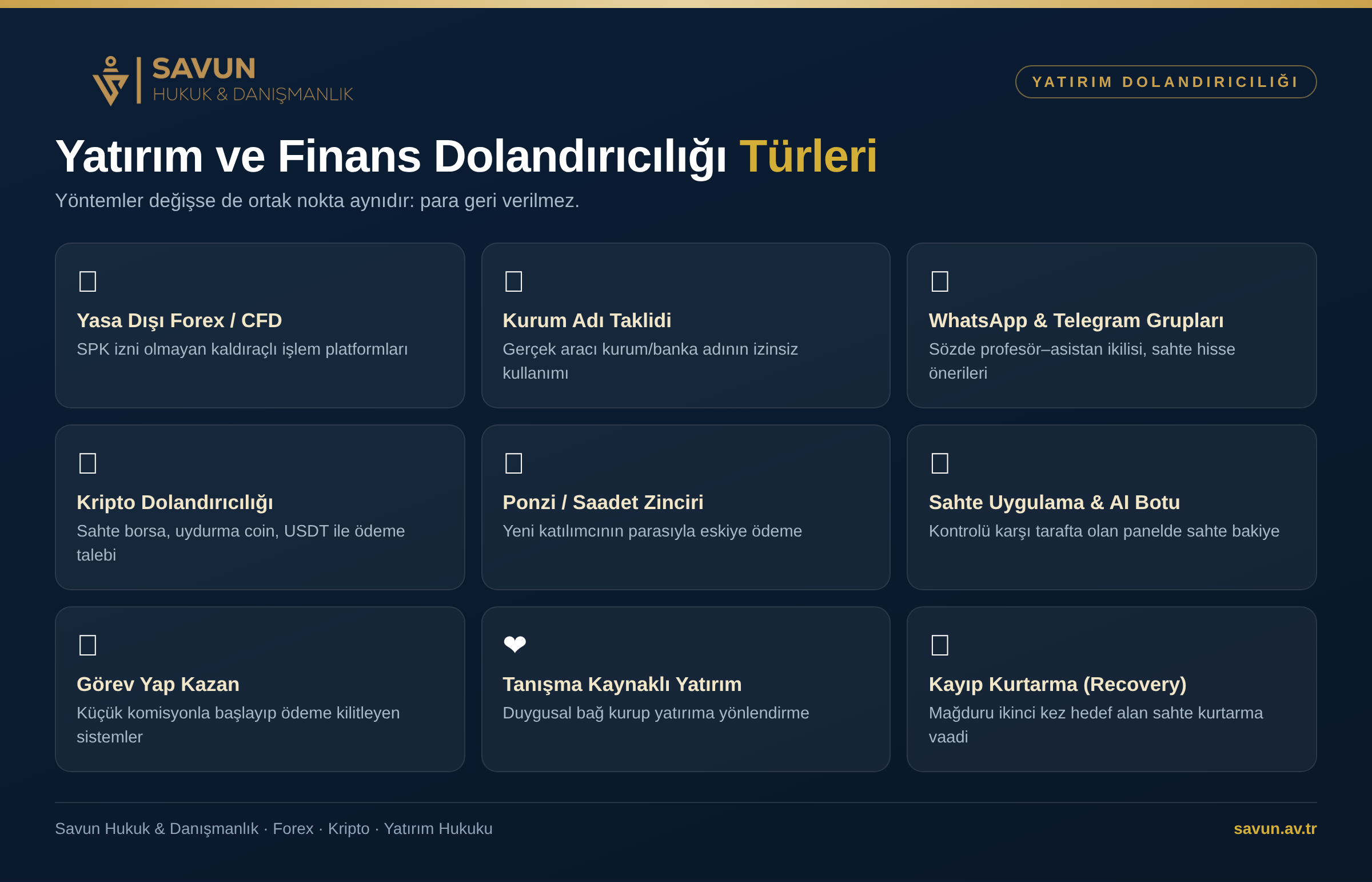
| Type | How It Works | Distinguishing Sign |
|---|---|---|
| Illegal forex / CFD | A leveraged trading platform without SPK permission; made to look attractive with high leverage and bonuses | Not on the SPK list; no Takasbank (Istanbul Settlement and Custody Bank) account is opened |
| Imitating an institution's name | The name, logo and MERSİS (Central Registry System) details of a real brokerage, bank or public body are used | Money is requested to an account that does not match the institution's registered name |
| WhatsApp / Telegram groups | Identities in "professor" and "assistant" roles share so-called analyses produced with artificial intelligence | Unverifiable accounts in the group that only talk about profits |
| Crypto fraud | A fake exchange or invented coin; payment is requested in crypto assets such as USDT | Payment accepted only in crypto |
| Ponzi / pyramid scheme | Earlier participants are paid with incoming new money; the system collapses when new joining stops | A promise of extra earnings for bringing in referrals |
| Fake app / "AI bot" | People are steered to the fraudsters' own app with a claim of AI-assisted automatic trading | The app is either absent from the official stores or has only just been published |
| Task scam ("complete tasks and earn") | Starts with small commissions; deposits are extracted under the name of "completing the set" | A condition to top up the balance first before the earnings can be withdrawn |
| Investment from a dating contact | A trust relationship built on social media or a dating app is turned into an investment | Investment guidance from a person never met face to face |
| Loss recovery | People who were defrauded before are made to pay a second time with "let us recover your money" | A "recovery expert" who contacts you although you never asked |
We examine real-world examples of these types, firm by firm, in our compilations stock and investment fraudstersTR and WhatsApp stock and investment fraudstersTR.
🔁 The 7 Stages of the Fraud
Almost all of the operations working under different brand names follow, surprisingly, the same order. Knowing this outline helps a person recognise which stage they are at:
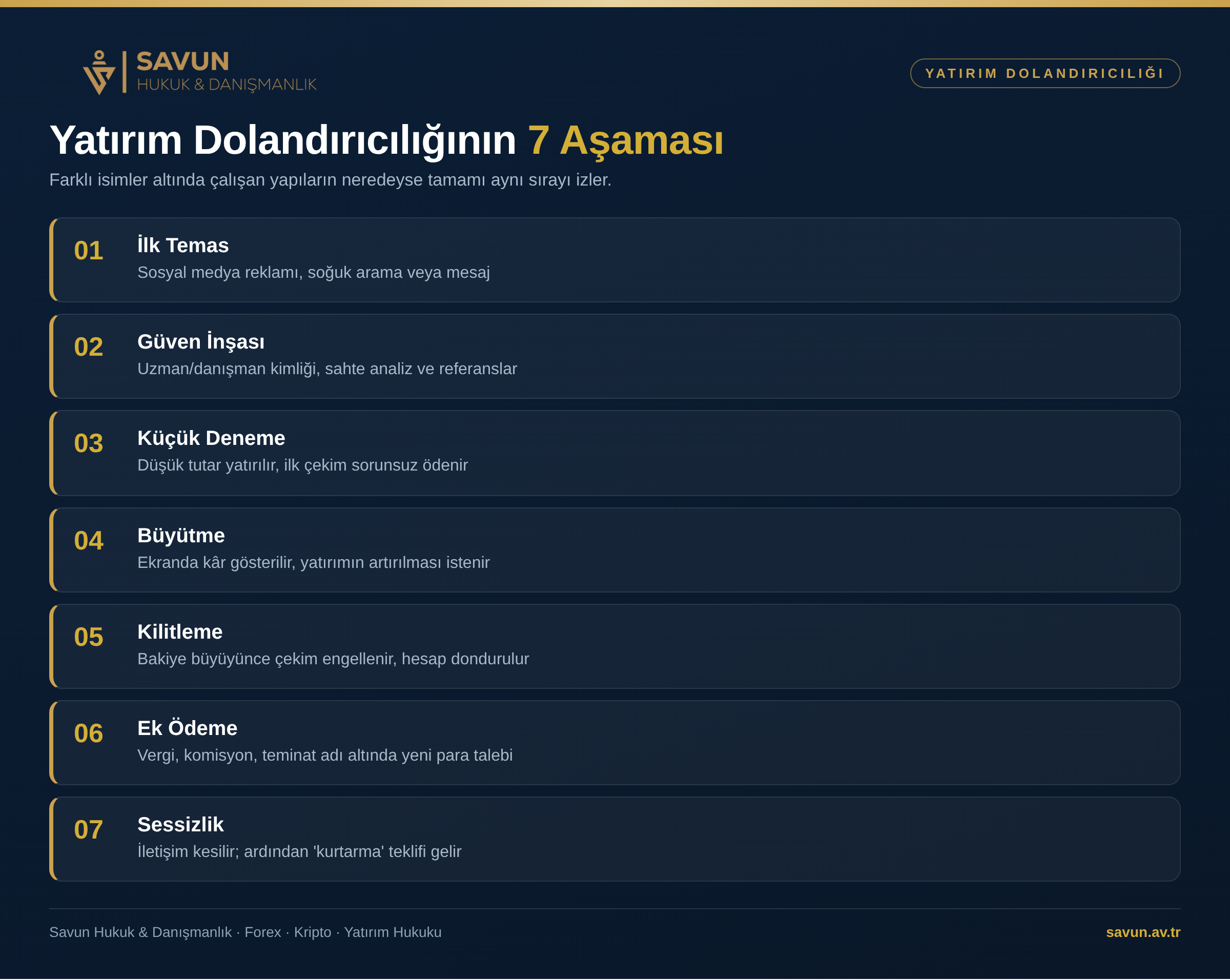
- 1. First contact: A social media ad, a cold call, a message or a group invitation. The person does not reach out; they are reached.
- 2. Building trust: "Expert", "adviser" and "professor" identities; fake certificates, awards and references; the presence of a corporate-looking website.
- 3. Small trial: A low amount is deposited and the first withdrawal is deliberately paid without problems. This is presented as the strongest proof that the system works.
- 4. Scaling up: Rapidly rising profit is shown on the screen; under headings such as "opportunity", "campaign" and "VIP account", a larger investment is requested. At this stage steering towards taking out a loan is also seen.
- 5. Locking: When the balance reaches a serious level, withdrawal requests go unanswered; the account is frozen on grounds of "security", "review" or "protocol".
- 6. Extra payments: Tax, withholding tax, commission, collateral, arbitrage fee, account verification fee… As each payment is made, a new item is produced.
- 7. Silence: Advisers and support lines become unreachable. Shortly afterwards a new team appears, this time saying "let us recover your money".
🧠 Psychological Manipulation Techniques Used
Investment fraud is less a technical event than a form of persuasion engineering. The answer to the victims' question "how was I fooled?" usually lies in the following techniques:
| Technique | How It Looks in Practice |
|---|---|
| Authority | Titles such as "professor", "fund manager" and "corporate analyst"; photos in suits, fake diplomas and certificates |
| Social proof | Accounts of unverifiable identity constantly sharing screenshots of profits in the group |
| Scarcity and urgency | "The quota is filling", "the trade closes today", "the window of opportunity is 2 hours" |
| Reciprocity | Free "analysis", gift bonuses, payment of the first withdrawal — creating a feeling of being indebted |
| Sunk cost | The logic of "you have put in this much, add a little more and save it all" |
| Isolation | Rhetoric that cuts the person off from those around them, such as "do not tell your family, they will be jealous" and "this information is private" |
| Intimidation | Preventing the victim from seeking their rights by saying "you did something illegal too" |
🚩 Danger Signals: Warning Signs
If even one of the items below is present, it is necessary to stop and verify before any transaction. If several are present together, the picture is largely clear:
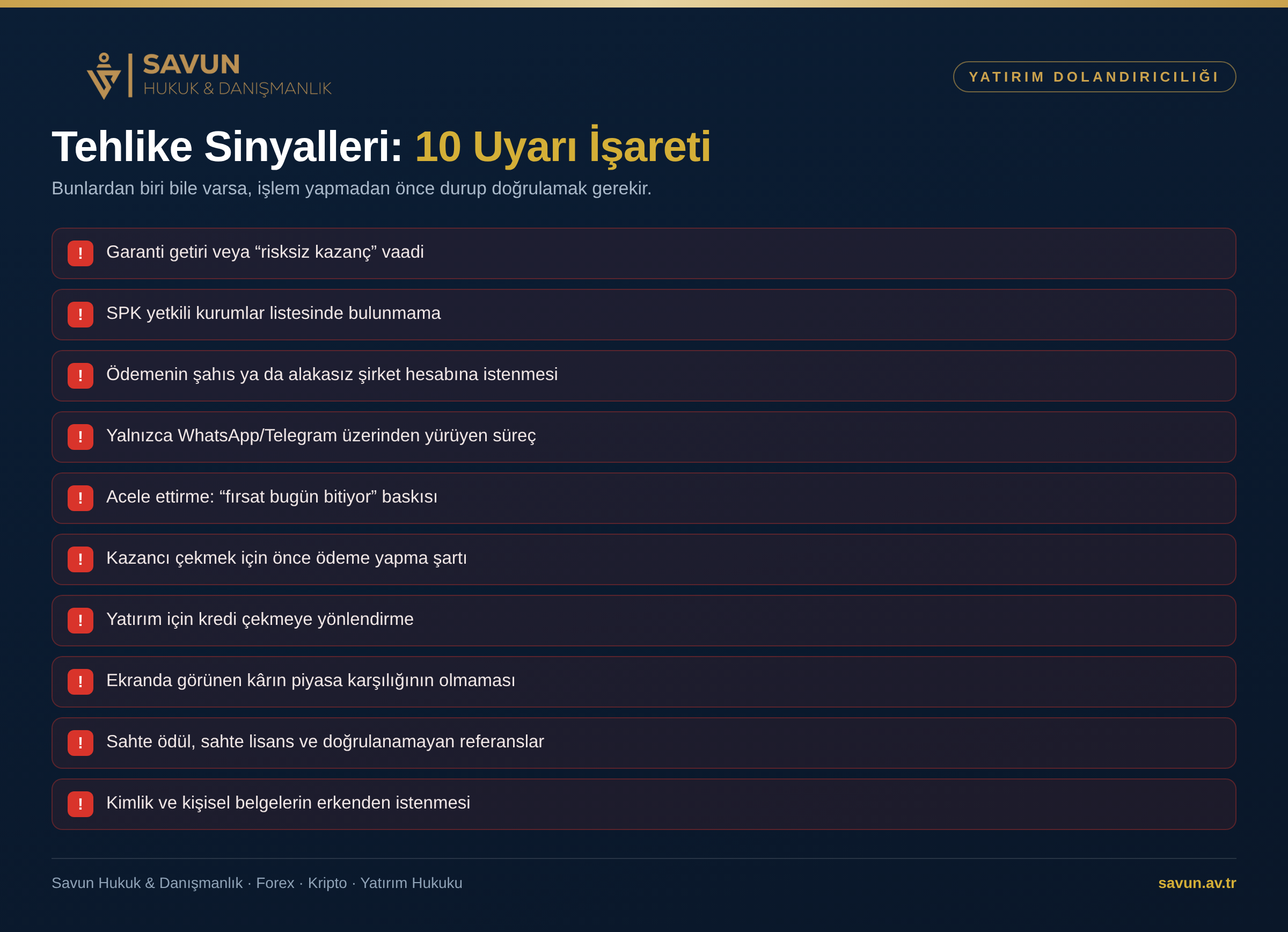
- A promise of certain, risk-free returns. No authorised institution can commit to a particular profit; risk is inherent in every investment.
- Absence from the SPK list. If the institution's name is not among the authorised intermediary institutions, everything else is detail.
- Payment to an individual's or an unrelated company's account. Accounts of companies set up in fields such as food, textiles, tourism and construction are used as fronts.
- A process run only through messaging. No investment process that proceeds without a contract, a risk profile and corporate registration is institutional.
- A condition to pay first in order to withdraw the profit. Every demand under the name of tax, commission, collateral or "verification fee" falls into this category.
- Steering towards taking out a loan. The riskiest stage, which turns a loss into lasting debt.
- Rushing and pressure. Any offer that leaves no time to think is suspicious.
- Unverifiable awards, licences and references. Badges on a site should be clickable and verifiable.
- A structure that keeps changing brands. The same team using new names at short intervals is a typical pattern.
- A request for ID and documents at an early stage. ID images in unauthorised hands are a separate source of harm.
🔎 Is an Institution Authorised? Verification Steps
A few minutes of checking before an investment decision eliminates most attempts at the very first step:
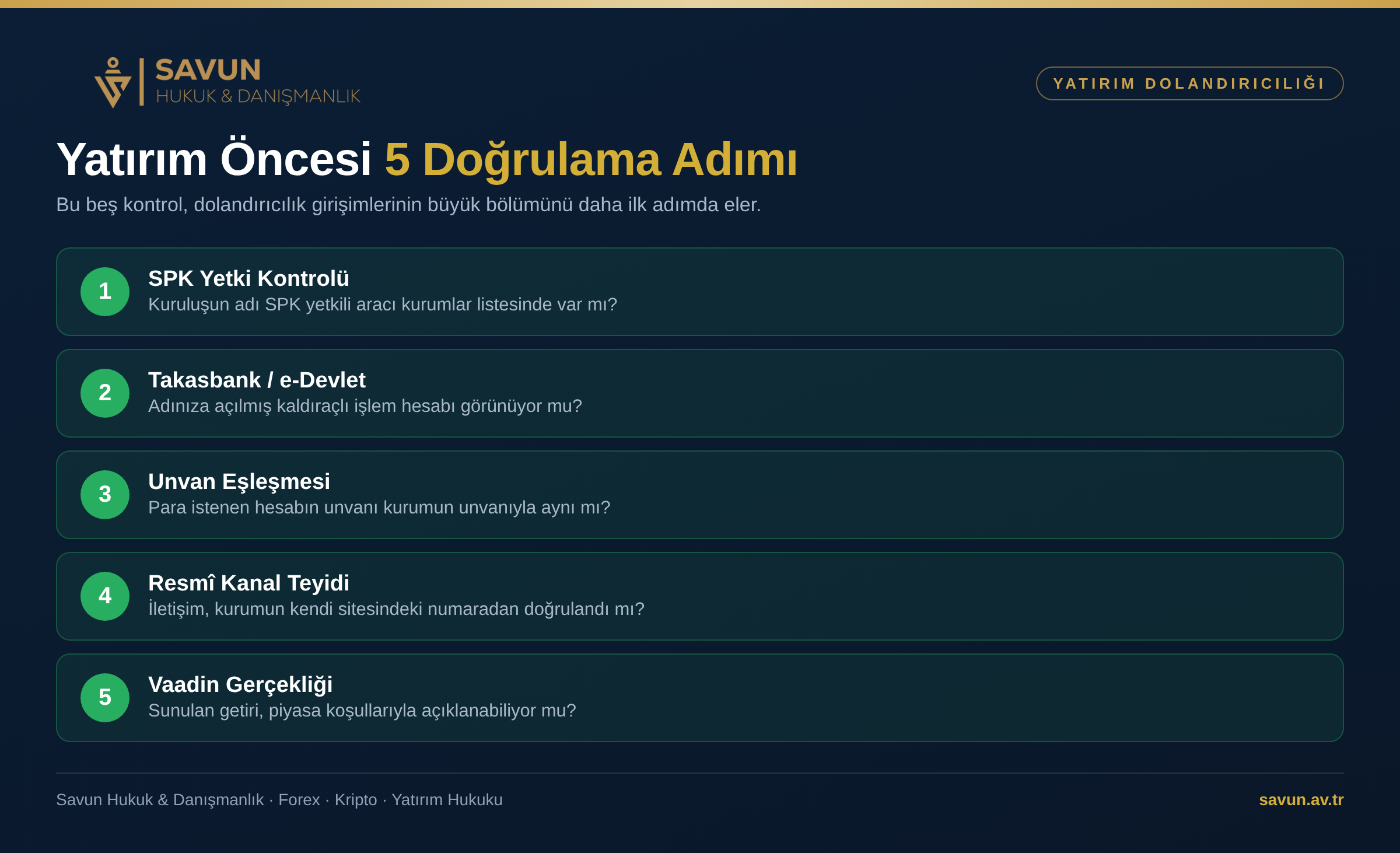
- SPK authorisation check: Is the institution's name on the SPK list of authorised intermediary institutions? A claim of a foreign licence does not remove this requirement.
- Takasbank and e-Devlet (the Turkish e-government portal): At authorised institutions an account is opened in the investor's name; a leveraged trading query can be made through e-Devlet. If no record appears, there is no institutional account.
- Company type and name: SPK-authorised intermediary institutions have joint-stock company status. The name of the account to which payment is requested must match the name of the institution one is dealing with exactly.
- Confirmation through an official channel: The contact details on the institution's own official website are used, not the number given to you. Most cases of imitating an institution's name come to light at this step.
- Plausibility of the promise: It is worth looking at whether the return offered can be explained by market conditions. A return that cannot be explained is not a real return.
📜 Legal Framework: Which Offences Come into Play?
Investment fraud is not limited to a single provision; depending on the nature of the event, more than one offence may come into play at the same time:
| Offence / Regulation | Scope |
|---|---|
| Qualified fraud Turkish Penal Code (TCK) Art. 158 |
Fraud committed by using information systems, banks or credit institutions as a tool. Tried before the High Criminal Court. |
| Unauthorised capital markets activity Capital Markets Law No. 6362, Arts. 109–110 |
Providing investment services and activities without SPK permission; unauthorised public offerings and unauthorised intermediation. |
| Laundering of proceeds of crime TCK Art. 282 / Law No. 5549 |
Moving the money obtained from the fraud between accounts so as to hide its trail. |
| Establishing / belonging to a criminal organisation TCK Art. 220 |
May come into play in operations that work with a division of labour such as call centre, software, account supply and money transport. |
| Unlawful processing of personal data TCK Art. 135 et seq. |
Obtaining and using ID images and contact details without permission, unauthorised calls. |
The change brought by the 12th Judicial Package
Under the paragraph added to Article 158 of the TCK by Law No. 7589, which entered into force on 31 July 2026, the penalty is reduced by half for persons whose contribution to the offence is limited to giving their account, card or the information enabling the account to be used to another person. The provision covers accounts held at brokerages, payment institutions and crypto asset service providers as well as bank accounts. For details of the whole package, see our 12th Judicial Package guideTR.
💡 Solution: Routes Available for Getting Money Back
The most frequently asked question is a single one: "Will I get my money back?" No firm assurance can be given in any case; however, because the money in investment fraud can be traced, concrete possibilities arise in most cases. Since the bulk of the money is transferred to bank accounts or crypto wallets in Türkiye, following its movement is possible. The main routes that come into play are as follows:
| Route | Function | Key Feature |
|---|---|---|
| Criminal investigation | An investigation conducted under qualified fraud | Identification of accounts, money movements and suspects |
| Precautionary attachment (freezing order) | Placing a block in advance on the other side's assets and accounts | The fastest protective measure; prevents assets being moved away |
| Enforcement proceedings | Collecting the receivable on the basis of receipts and records | Possibility of practical results on front company and individual accounts |
| Monetary claim / compensation claim | Requesting from the court the return of the amount sent | A final result on the merits |
| Chargeback | A dispute process for payments made by credit/debit card | The most practical route for card payments; the time limits are short |
| Crypto tracing | Following a transfer through the wallet address and transaction ID | Identifying the counterparty where the asset reaches an exchange |
Which route takes priority varies with how the payment was made (bank transfer, card, crypto), who the money went to and how much time has passed since the event. For the detailed course of the process, see our forex refund and legal process guideTR. On the rules for temporary suspension of accounts, we have covered the practice under Article 128/A of the Code of Criminal Procedure (CMK)TR.
🪙 The Position in Crypto-Related Losses
Contrary to popular belief, a request for payment in crypto assets does not mean the trail is completely lost. Every transfer on the blockchain leaves a permanent record. In crypto-related cases, the following elements are therefore important:
- Wallet addresses: The address the funds were sent to is the starting point of on-chain tracing.
- Transaction IDs (TXID / hash): The unique record of each transfer; it confirms the amount, date and recipient.
- Exchange records: If the transfer reaches an exchange, identifying the account holder on that platform may come into play.
- Screenshots of transfers and withdrawals: They show the integrity of the process.
Platforms such as Binance, Paribu and BTC Türk are lawful crypto asset service providers; in such cases they are mostly only a means of transfer. The fraud itself lies in the scheme that steers the person to pay through these platforms.
🎣 The Second Trap: Loss Recovery Fraud
The second wave that follows a loss can be more devastating than the first. The data of people who were defrauded earlier is either kept by the same team or passed on to other groups. After a while a message arrives with this content: "We recover your lost funds through legal channels."
💳 The Position of Those Who Let Their Account Be Used (IBAN Renting)
The less discussed side of investment fraud is the owners of the accounts the money passes through. People who hand over their account or card to someone else on an offer such as "a transaction will be made, let us use your account, you get a commission" often, without fully grasping what is going on, fall into the position of a participant in the fraud.
The 12th Judicial Package has brought a limited balance to this picture; a reduction of half in the penalty is provided for persons whose contribution is limited to giving an account or card. However, this does not mean the act ceases to be a crime. Letting one's account be used for a short-term commission means facing both a criminal investigation and the victims' monetary claims.
⛔ Common Mistakes After a Loss
- Making new payments. None of the demands such as tax, commission, collateral or "one last transaction" releases the money.
- Deleting records. Correspondence, receipts, screenshots and crypto transaction IDs form the basis of the process.
- Believing a promise that a refund is certain. Any operation that says a refund is certain carries the risk of a second loss.
- Waiting out of guilt. Investing on an unauthorised platform is not a crime; delay only benefits the other side.
- Trying to cover the loss by borrowing. An attempt to "recover the loss" with a loan makes the loss permanent.
🛡️ Prevention: Pre-Investment Checklist
The most effective solution is for the process never to begin. Before an investment decision, the following principles neutralise almost all known methods:
- Authorisation is verified not from the institution's own statement but from the SPK list.
- The name of the account to which payment is made is required to be the same as the institution's name.
- The person who contacts you is confirmed through the contact channel on the institution's official website.
- The return is questioned: a profit that cannot be explained is not a real profit.
- No offer that creates haste is accepted on the same day.
- Borrowing for an investment is never advisable; investing with a loan is the riskiest scenario.
- ID and document sharing is limited to institutions whose authorisation has been verified.
- Before investing, it is also worth checking whether a platform is authorised by the regulator in your own country (for example the FCA, ASIC or SEC).
🏛️ The Savun Law & Consultancy Approach
In losses arising from forex, crypto and investments, we conduct the whole process on behalf of our client. At the centre of our work is not a right that stays on paper but a practical result: we focus on claiming back the balance by placing enforcement blocks on the bank accounts of front companies and individuals. We work with experience in a large number of comparable cases, enforcement and attachment proceedings, and expertise in crypto asset tracing. On request, we can share our precedent decisions and examples of collection and bank attachment proceedings with you.
For detailed information and legal support, you can contact Savun Law & Consultancy.
❓ Frequently Asked Questions
Will I get my money back in investment fraud?
Is trading on an illegal platform a crime?
What is the limitation period in investment fraud?
How can I tell whether a platform has SPK authorisation?
I received my first withdrawal without problems. Does that mean the platform is reliable?
Is it normal to be asked for tax or commission to withdraw profit?
I paid with crypto. Can it be traced?
I was called in the name of a well-known institution. Could it be genuine?
Can people who say "let us recover your money" after a loss be trusted?
I let my account be used. What is my liability?
I have only just realised I was defrauded. Is it too late?
I am a victim. What should I do?
🔗 Related Content
- Forex Refund and Legal Process GuideTR
- Stock and Investment FraudstersTR
- WhatsApp Stock and Investment FraudstersTR
- 12th Judicial Package (Law No. 7589): All ChangesTR
- CMK Art. 128/A: Suspension of Accounts in Forex and CryptoTR
- HAGB and Suspension in Investment FraudTR
- The "Professor–Assistant" Scheme in WhatsApp Stock GroupsTR
Disclaimer: This content has been prepared for general information only and does not constitute legal advice. Because every case has its own circumstances, outcomes vary with the nature of the case, the payment method and timing. The real institutions and platforms mentioned in the content are parties whose names are used without permission and cannot be associated with acts of fraud. The information in this article may not be up to date; Savun Law & Consultancy cannot be held responsible for decisions taken on the basis of it. For detailed information and legal support, you can contact Savun Law & Consultancy.
This page is an English adaptation of our Turkish article Yatırım ve Finans Dolandırıcılığı ve Çözümü.
More from Investment Fraud & Crypto Law in Türkiye
- Crypto Account Frozen Under MASAK Article 19/A: Court Ruling
- Foreign Investment Loss: Istanbul Appeal Court 2025/1699 Ruling
- Citizenship-for-Investment Promise Fraud: Turkish Court Ruling
- Foreign Element in Crypto Assets: Governing Law and Court
- Crypto Asset Injunction and Attachment in Türkiye
- Forex Case: Broker-Steered Trades, Ankara Court 2025/1287