
Can Investors Sue SPK for Forex Losses? Council of State Ruling
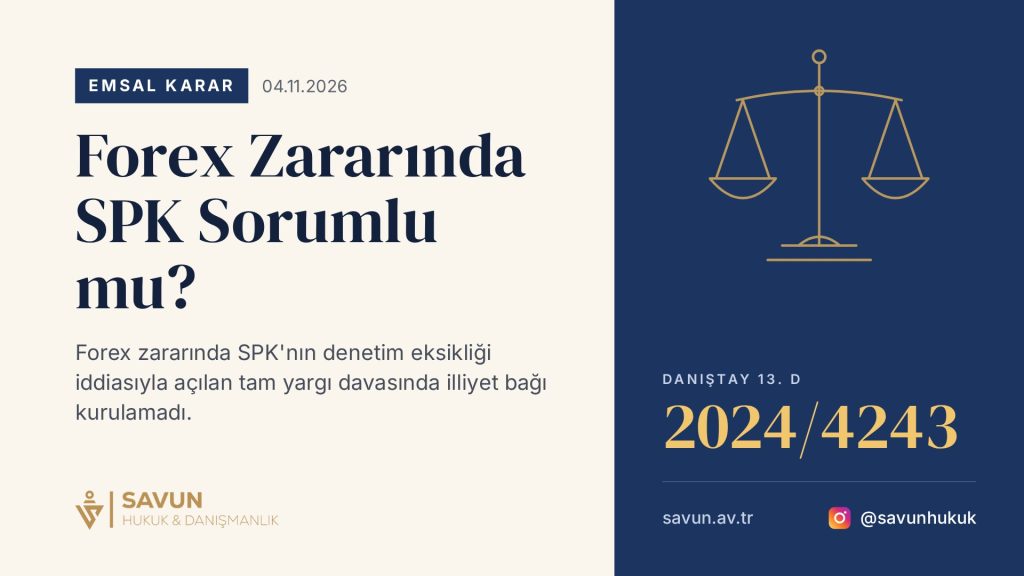
Can an investor who has lost money in leveraged trading look for the person responsible not only in the brokerage firm, but also in the public authority that regulates and supervises the market? In administrative courts the answer to this question takes the form of a full remedy action: the investor argues that the Capital Markets Board (SPK) did not regulate the forex market in a way that protects investors and did not supervise intermediary institutions in time, and asks the administration to compensate the loss. In the case examined by the 13th Chamber of the Council of State (Danıştay), this claim failed at all three levels; the decision also contains a procedural finding on the period within which a party that missed the appeal deadline can still exercise the right of appeal through its response petition.
In its decision of 23.10.2024, Docket No. (E.) 2020/3081, Decision No. (K.) 2024/4243, the 13th Chamber of the Council of State affirmed unanimously and finally the regional administrative court decision that had rejected the appeal against the dismissal of a claim for TL 380,000.00 in material damages based on the Board's service fault; it rejected as out of time the Board's appeal concerning the attorney's fee.
- The investor's claim: TL 380,000 and service fault
- The administrative court: the risk was knowingly assumed
- Grounds raised on appeal
- The Council of State: affirmed as to the claimant
- The Board's appeal: the response petition and 30 days
- What the decision says and what it does not
- Frequently asked questions
💱 The investor's claim: TL 380,000 and service fault
The claimant opened an account with an authorised institution in order to invest in the leveraged trading market and suffered a loss as a result of the transactions. The case was brought not against the intermediary institution but against the Capital Markets Board. The core of the argument is that a public service was run badly:
- The Board did not regulate leveraged trading markets, known as forex, in a way that protects investors.
- The intermediary institutions operating in the market were not supervised in time and effectively.
- The Board did not fulfil its duties and responsibilities, and a service fault therefore arose.
On these grounds, payment of TL 380,000.00 in material damages with statutory interest was requested. The claimant's request for legal aid was accepted by the administrative court.
📉 The administrative court: the risk was knowingly assumed
The administrative court first set out the regulatory history of the market. According to the decision, until 2011 leveraged transactions were carried out under the market's own rules, without any oversight or supervision. After complaints, a communiqué on leveraged trading transactions was issued under the repealed Capital Markets Law No. 2499, and with a press release dated 31.08.2011 the Board announced that these transactions could be carried out only by institutions it had authorised.
The court explained that the Board did not remain inactive after that date, on the basis of the following facts:
- Criminal complaints were filed and administrative fines were imposed against institutions operating without permission.
- Compliance with the conditions of the communiqué was inspected at regular intervals.
- The claimant was given a risk disclosure form when the account was opened; the form stated clearly the fees and commissions, that the transactions were very risky, that the authorised institution's recommendations might be incomplete and in need of verification, and that losses could be suffered when prices moved in the opposite direction.
According to the court, it is clear that the claimant suffered a loss; however, the loss arose largely from the realisation of a risk that is inherent in the transactions and that was known to the claimant from the very beginning. Because the loss could not be said to result from the administration's services failing to function, functioning late or functioning badly, no adequate causal link could be established between the administration's actions and the loss. The court also pointed out that, in the same period and in the same market, there were people and institutions that traded and obtained the benefit they hoped for.
The claim was dismissed, and a fixed attorney's fee of TL 1,362.00 was ordered to be collected from the claimant and given to the administration. The regional administrative court rejected the parties' appeal applications under Article 45/3 of the Administrative Procedure Law No. 2577.
🗂️ Grounds raised on appeal
In the appeal petition, the claimant tried to prove the service fault through general market conditions. The main allegations reflected in the text of the decision are as follows:
- Public officials explained that if intervention in the market had been delayed a little longer, very great harm would have resulted.
- Highly leveraged over-the-counter transactions were abolished only on 10.02.2017.
- Small investors lost consistently while intermediary institutions won; the matter came onto the agenda of a parliamentary inquiry committee.
- Advertisements by intermediary institutions that misled investors were not supervised and were banned only later.
- Many reports stated that forex transactions are not suitable for the general investor, and that other countries have not permitted such high leverage ratios.
In its defence, the Board stated that the necessary regulations had been made, that investors are responsible for their investment decisions and the applications they use, and that leveraged transactions were inspected more frequently. The Board also argued that, in a case concerning money, a proportional rather than a fixed attorney's fee should have been ordered, and requested that the decision be affirmed with a correction.
🏛️ The Council of State: affirmed as to the claimant
The 13th Chamber of the Council of State made a short assessment of the claimant's appeal request. A regional administrative court decision can be reversed only if one of the grounds listed in Article 49 of Law No. 2577 exists. The Chamber stated that the decision under appeal complied with procedure and law and that the grounds in the appeal petition were not of a kind requiring reversal, and it affirmed the decision.
The Chamber did not separately repeat the first-instance court's reasoning on the causal link; however, as a result of the affirmation, the judgment dismissing the case became final. The reporting judge also gave an opinion in favour of rejecting the claimant's appeal request and affirming the decision.
⏳ The Board's appeal: the response petition and 30 days
The second limb of the decision is procedural. The Board did not appeal the regional administrative court decision within its own appeal period; it raised its objection to the attorney's fee together with its response to the claimant's appeal. The Chamber examined this request on the basis of two provisions:
- Article 46/1 of Law No. 2577: The appeal period is thirty days from notification of the decision.
- Article 48/3 of Law No. 2577: The appeal petition is notified to the other party; the other party may respond within thirty days following the date of notification. Even if it did not appeal the decision in time, it may request an appeal in its response petition, and in that case the response petition takes the place of an appeal petition.
In the case, the claimant's appeal petition reached the Board's electronic notification address on 12.08.2020 and was deemed notified at the end of the following fifth day, on 17.08.2020. The Board's response petition containing its appeal request entered the court records on 23.09.2020. This application, made after the thirty-day response period had passed, was not examined because it was out of time. The provision on the fixed attorney's fee was therefore also left unchanged.
This finding shows that the possibility in Article 48/3, similar to a "joinder appeal", is not unlimited: a party that missed the main appeal period may request review depending on the other party's appeal, but it can do so only within the response period that runs from the notification made to it.
🔎 What the decision says and what it does not
The decision shows that, in compensation claims directed at the regulatory authority for forex losses, the causal link is decisive. According to the first-instance court's approach, where the investor was given a risk disclosure and the market has been placed under a licensing and supervision regime since 2011, the loss is regarded as arising from market risk. While affirming this assessment, the Chamber did not set out a detailed statement of principle.
On the other hand, the scope of the decision is narrow. The dispute concerns market risk in an account opened with an authorised institution; unauthorised platforms, fake accounts or conduct by the intermediary institution in breach of contract were not discussed. In civil cases brought against an intermediary institution, liability is assessed under different criteria; for example, the decision on loss exceeding the collateral in leveraged tradingTR can be consulted.
A different example of a full remedy action against the Board is the decision on a service fault claim against SPKTR, which concerns liability alleged because of a prospectus approval. For an example of the sanctions the Board applies to forex intermediary institutions, the decision on the demo account obligationTR can be examined.
❓ Frequently asked questions
In which court was the compensation claim against SPK for forex losses brought?
Why did the court reject the compensation claim?
Does the later limiting of high leverage ratios prove a service fault?
Why was SPK's objection to the attorney's fee not examined?
For detailed information and legal support, you can contact Savun Law & Consultancy. Contact details are on the contact page; other decisions on leveraged trading and capital markets disputes can be followed on the Precedent DecisionsTR page.
This article is for general information only; its content is compiled from the affirming decision of the 13th Chamber of the Council of State published through Bedesten (mevzuat.adalet.gov.tr). The decision is based on leveraged transactions carried out with an authorised institution and on the regulatory framework of the 2011-2017 period; party names are anonymised in the source. In a dispute that looks similar, the outcome may differ depending on whether the institution where the transactions were made was authorised, the content of the risk disclosure, the source of the loss and the specific act or omission of the administration. Savun Law & Consultancy cannot be held responsible for any application, lawsuit or defence made on the basis of this article.

Questions & answers · Istanbul Bar Association 75235
Have a question about this topic? Ask our lawyer.
Write your question and Attorney Veli Savun will answer it on this page. You do not need to give your name.
Example questions — tap one and adapt it to your situation:
Answers are general information only; they do not create a lawyer–client relationship and are not legal advice on your specific case. All questions & answers →
Have a question? Attorney Veli Savun answersThis page is an English adaptation of our Turkish article Forex Zararında SPK Sorumlu mu? – Danıştay 13. D 2024/4243.
More from Investment Fraud & Crypto Law in Türkiye
- Forex Robot Allegation: Istanbul Appeal Court Ruling 2025/1669
- Forex Profit Cancelled: Council of State 13th Chamber 2025/92
- Deepfake Celebrity Ad Investment Scam Explained
- Forex Scam With Overseas Fraudsters: Can Money Be Traced?
- WhatsApp Investment Group Scam: How It Works
- Can't Withdraw Money From a Forex Account? What It Means