
Lawsuit Against a Dissolved Company: Istanbul Appeal Court 2025/513
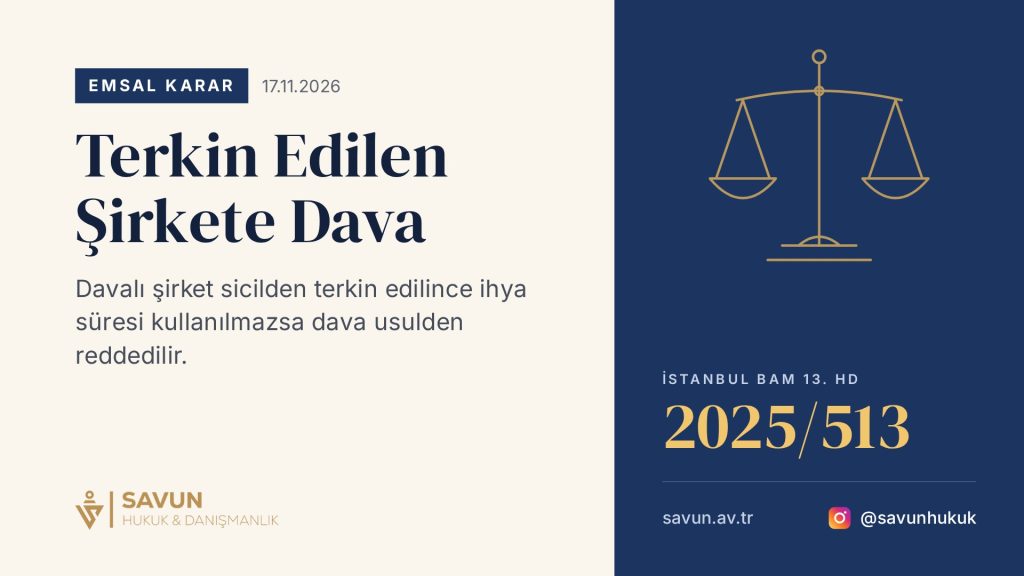
Investors who open an account with a forex platform found on social media are often asked to send the money not to the platform itself but to domestic companies carrying names such as "consultancy" or "education". When the loss comes to light, the investor starts enforcement proceedings against these companies and, once an objection is raised, files an action to annul the objection. But what happens when the case drags on for years in disputes over jurisdiction, and the defendant company is liquidated and deleted from the trade registry? The Istanbul Regional Court of Appeal 13th Civil Chamber found it correct that, in such a case, the claim was dismissed on procedural grounds because no revival action had been brought, and that legal fees were awarded in favour of the lawyer of the deregistered company.
By its decision of 27 March 2025, Docket No. E.2025/439, Decision No. K.2025/513, the Istanbul Regional Court of Appeal 13th Civil Chamber rejected the claimant's appeal against the first-instance judgment, which had dismissed on procedural grounds an action to annul an objection arising from a leveraged trading relationship under Articles 114/1-d and 115/2 of the Code of Civil Procedure No. 6100 (HMK). The appeal was rejected on its merits, unanimously and with final effect.
📱 The investor's account of events
According to the statement of claim, in the second half of May 2020 the claimant opened an account with a firm he had come across through internet advertising and social media, and began leveraged market trading on that firm's platform. Two officials of the firm sent daily market news and trading suggestions over WhatsApp.
After a while the claimant suspected that the suggestions were meant to make him lose and the firm win. He stopped trading after a loss of 200 USD and did not trade between June and September. In the first days of September 2020, however, following intensive messages and calls from a firm employee, and because he needed money after his business was disrupted during the pandemic, he started trading again, at first with amounts of 100 and 200 USD. By the time he realised he had been defrauded, the claimant says he had lost a total of 35,700 USD (about 260,000 TL).
What makes the case different is where the money was sent. According to the claimant, on the direction of the firm's employees, EFT and bank transfers were made to the accounts of various consultancy companies, and the relationship of these companies with the firm is unknown. The amount sent to the defendant company was 28,515 TL. The claimant stated that he had no connection with this company and had received no service from it, and that sending money to such a company could not be explained other than by that direction. He sought annulment of the objection to the enforcement proceedings he had started, together with enforcement denial compensation.
🛡️ The defendant company's defence
The defendant company's lawyer first argued that the court lacked jurisdiction, that the competent court was the commercial court of first instance, and that the platform firm should be joined to the case or notified of it. On the merits, the following defences were made:
- The company owed the claimant nothing; the transfer concerned the payment of a debt.
- The claimant made the transactions of his own free will and, as the screenshot attached to his petition shows, traded with 1:400 leverage, thereby accepting the risk of loss at that ratio.
- A decision of non-prosecution had been given in the investigation file of the Istanbul Anadolu Chief Public Prosecutor's Office on the same incident.
- The company had no employee with the name the claimant gave; the advisers only made suggestions and did not force anyone to trade.
The defendant also asked that, together with dismissal of the claim, compensation for bad faith be awarded against the claimant. None of these defences was examined on the merits; the case ended on procedural grounds.
🗺️ A journey through three courts over jurisdiction
The decision shows, with concrete dates, how time is used up in cases of this kind:
- 18 May 2021: The case was filed at the Istanbul 11th Consumer Court.
- 4 June 2021: The defendant company's lawyer submitted his power of attorney to the file.
- 8 February 2022: The consumer court declined jurisdiction on the ground that the dispute fell within the remit of the commercial court.
- 20 April 2022: The liquidation of the defendant company was registered and the company was deleted from the trade registry.
- 7 April 2023: The Istanbul 13th Commercial Court of First Instance, to which the case had been sent, decided to refer it for allocation to the Istanbul 6th, 7th, 8th and 9th Commercial Courts of First Instance, designated as finance specialist courts.
- 26 April 2023: The case was allocated to the Istanbul 6th Commercial Court of First Instance.
- 5 April 2024: The defendant's lawyer announced his withdrawal from the case.
- 25 April 2024: The court gave the claimant a final period to bring a revival action.
- 7 November 2024: Because the final period was not used, the case was dismissed on procedural grounds.
- 27 March 2025: The Regional Court of Appeal rejected the appeal on its merits.
Notably, the defendant company had already been deleted from the registry while the case was still pending, before it was sent from the consumer court to the commercial court. The deregistration was reported to the court only by a letter dated 11 December 2023 from the Istanbul Trade Registry Directorate.
⚖️ Deregistration, the final period and dismissal on procedural grounds
Article 114/1-d of the Code of Civil Procedure (HMK) lists capacity to be a party and capacity to sue among the conditions for bringing a case. Because the legal personality of a company deleted from the trade registry ends, it cannot take part in a case as a party unless it is registered again. Article 115/2 of the HMK provides that, where a missing procedural condition can be remedied, the court gives a final period for this, and if the defect is not remedied within that period the case is dismissed on procedural grounds.
In the case at hand, the first-instance court applied this scheme step by step. At the hearing of 25 April 2024, the claimant was given a final period to submit, by the next hearing, the petition showing that a revival action had been brought together with the allocation form, and was warned that otherwise the case would be dismissed on procedural grounds. The next hearing was set for about seven months later, 7 November 2024.
By a petition dated 7 November 2024, the claimant's lawyer gave an excuse and asked for a new final period of two weeks. The court accepted the excuse and continued in his absence, but rejected the request for a new period, citing its earlier interim decision, the roughly seven months between the two hearings, the fact that the case was subject to the simplified procedure, and the principle of procedural economy. The case was dismissed on procedural grounds under Articles 114/1-d and 115/2 of the HMK.
The re-registration of a company for the purpose of additional liquidation is known in practice as a revival action and is regulated for joint-stock companies in Article 547 of the Turkish Commercial Code (TTK). Under this provision, where additional liquidation steps are needed after liquidation has closed, creditors too may ask the commercial court of first instance at the place of the company's seat to have the company registered again. For limited companies, Article 643 of the TTK refers to the joint-stock company provisions on liquidation procedure.
💼 Why was the objection to the legal fees rejected?
The claimant's appeal was directed not at the dismissal on procedural grounds but only at the 29,352.88 TL proportional legal fee awarded in favour of the defendant. According to the claimant, the defendant's lawyer resigned on 5 April 2024, so the power of attorney had ended, and awarding a fee in the decision of 7 November 2024, given after the resignation, was wrong; at most a fee could have been set for the work done up to the resignation.
The Regional Court of Appeal did not accept this view. The defendant company's lawyer had submitted his power of attorney on 4 June 2021, the company was deregistered on 20 April 2022, and the lawyer withdrew on 5 April 2024. According to the chamber, the defendant was represented by a lawyer at the first hearings until the date of its deletion from the registry; awarding a legal fee in the defendant's favour was therefore consistent with procedure and law. The appeal was rejected on its merits under Article 353/1-b-1 of the HMK, and the decision was given as final under Article 362/1-a of the HMK.
As a result, in a case brought over a claim of 28,515 TL, the claimant faced a legal fee exceeding that amount without the merits ever being reached.
📝 Points that emerge for similar cases
- The defendant's registry status matters: Companies to which money was sent may be liquidated and deleted within a short time. If deregistration occurs while the case is pending, the capacity to be a party falls away.
- A final period is final: Where a revival action is not brought, and proof of it not submitted, within the final period the court gave, the court is not obliged to grant extra time, even after a long interval.
- Jurisdiction disputes cost time: In this case the action was filed at a consumer court, then sent to the general commercial court of first instance and from there to a finance specialist court. Filing at the consumer court meant that roughly the first two years of the process were spent on arguments over jurisdiction and the division of work.
- A dismissal carries legal-fee risk: Even in dismissals on procedural grounds, a legal fee may be awarded where the other side was represented by a lawyer; the lawyer's later withdrawal does not remove this by itself.
On proof and legal interest in actions to annul an objection against intermediary companies, the decision on a claim against an overseas platform intermediary can be consulted; for allegations of direction by forex platform staff, the decision on separating directed transactions in forex. A general framework on the types of case and the competent courts is in the article on forex lawsuitsTR.
❔ Frequently Asked Questions
What happens to the case if the defendant company is deleted from the registry during the proceedings?
Can a new period be requested after the final period has expired?
Can legal fees be awarded to a defendant whose lawyer resigned?
Was recourse to the Court of Cassation open against this decision?
For detailed information and legal support, you can contact Savun Law & Consultancy. Contact details are on the contact page; other decisions on forex and investment disputes are on the Precedent DecisionsTR page.
This article is for general information only; its content is compiled from the final appeal decision of the Istanbul Regional Court of Appeal 13th Civil Chamber published in the Court of Cassation decision search system. Party names and the platform name are anonymised in the text of the decision. Because the case ended on procedural grounds, the investor's allegation of fraud and the defendant's defences were not examined on the merits. In a case that looks similar, the outcome may differ according to the defendant's registry status, the periods given, the date of the case and the court's assessment. Savun Law & Consultancy cannot be held responsible for applications, lawsuits and defences made on the basis of this article.

Questions & answers · Istanbul Bar Association 75235
Have a question about this topic? Ask our lawyer.
Write your question and Attorney Veli Savun will answer it on this page. You do not need to give your name.
Example questions — tap one and adapt it to your situation:
Answers are general information only; they do not create a lawyer–client relationship and are not legal advice on your specific case. All questions & answers →
Have a question? Attorney Veli Savun answersThis page is an English adaptation of our Turkish article Terkin Edilen Şirkete Dava – İstanbul BAM 13. HD 2025/513.
More from Investment Fraud & Crypto Law in Türkiye
- Bank Reversed a Deposit Without Consent: Court of Cassation 2023
- Recovery Scams: Warning Signs of Fake Fund Recovery Offers
- Forex Scheme Operation: How a Victim Joins the Case (2026)
- SIM Swap Fraud: Which Court Hears the Bank's Recourse Action?
- Money Sent to a Real Estate Agent for an Investment: Refund Ruling
- Refund of Fund-Sourcing Consultancy Fees: İzmir Appeal 2026/581