
Fake Investment Platform USDT: Crypto Exchange Liability Ruling
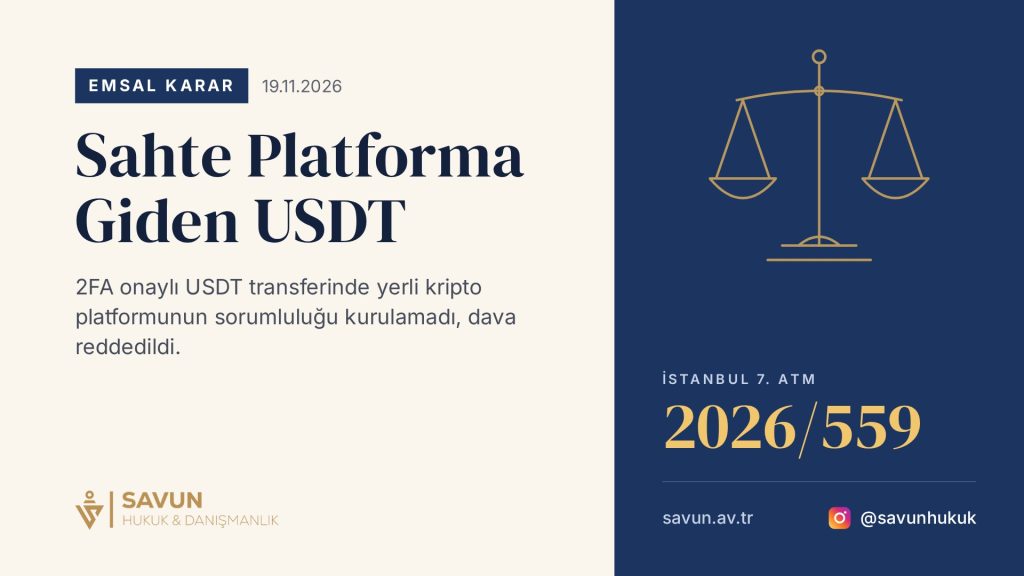
In the most common investment fraud scheme, the money is not sent directly to the fraudster. The victim first opens an account at a well-known domestic crypto asset platform, deposits Turkish lira, buys USDT and sends that USDT to wallet addresses provided by a person presented as an "investment adviser". Once the loss comes to light, the first question that comes to mind is this: can the domestic crypto platform, the last institution known to have handled the money, be held liable for the loss? The Istanbul 7th Commercial Court of First Instance answered this question through causation and the burden of proof in a case brought after a chain of transfers of roughly 276,000 USDT.
In its decision dated 15.09.2026, Docket No. E.2025/763, Decision No. K.2026/559, the Istanbul 7th Commercial Court of First Instance held that the crypto asset platform's execution of transfer instructions approved by the account holder through multi-factor authentication did not, on its own, create an adequate causal link with the loss arising on the fake investment platform, and dismissed the claim.
- From advertisement to Telegram: the path the money took
- The claimant's requests and the platform's defence
- Findings of the expert panel
- The court's reasoning and ruling
- Why technical intermediation was not enough
- The organic link claim and the burden of proof
- Law No. 7518 and its application in time
- Frequently Asked Questions
🧭 From Advertisement to Telegram: The Path the Money Took
The claimant became a member of the crypto asset trading platform operated by the defendant company on 05.04.2021, after completing the identity verification (KYC) process. According to the petition, the claimant, partly influenced by advertisements, turned to the stock and commodity markets through another platform with the aim of trading; the claimant states that spot trading came first, and that afterwards, through a person who presented himself as an investment adviser, the claimant began futures and leveraged trades whose risks had not been explained.
The correspondence in the case file clearly shows how the scheme was built: a user code and trading password were sent to the claimant on 16.03.2024, the claimant was asked to contact a person via Telegram on 18.03.2024, and an e-mail dated 21.03.2024 shared IBAN details in the name of a third-party limited company. The flow of money was: TRY from the bank to the domestic platform, purchase of USDT, transfer to external addresses and to another account, and from there to the third-party trading platform.
📨 The Claimant's Requests and the Platform's Defence
The case was first filed before a consumer court, and on that court's decision of lack of jurisdiction dated 21.02.2025 the file was sent to the commercial court of first instance. Reserving further rights, the claimant's lawyer requested two items of receivables:
- USD 10,000 for the time being, for assets that were deposited on the third-party platform and allegedly seized through data manipulation that produced a loss,
- USD 1,670 for the time being, for assets allegedly seized on the ground of a "so-called loss (negative balance)",
- For both items, the highest interest rate applied by public banks to one-year deposits in the same foreign currency,
- Because the proceedings would take a long time, an interim payment of USD 11,670 under Article 76 of the Turkish Code of Obligations (TBK).
The defendant platform argued that the transfers were made on the claimant's legally valid instructions, that the party answerable for the loss was the scheme run through the third-party website, that stock trading or leveraged trading was not possible on its own platform, and that it had no connection with the companies mentioned. The defendant also raised objections of mediation and lack of standing to be sued.
🔍 Findings of the Expert Panel
The court obtained a report dated 19.05.2026 from an expert panel made up of digital forensics, financial markets and computer engineering specialists. The main findings of the report that were reflected in the decision are as follows:
- The amount the claimant sent from the bank to the platform account in 2024 is TRY 7,986,500.00 according to the receipts; together with TRY 485,000.00 dated 26.03.2024 in the platform records, the total TRY deposit for 2024 is TRY 8,471,000.00.
- In 2024 USDT/TRY purchases totalling 258,968 USDT were made.
- Between 21.03.2024 and 31.05.2024, withdrawals/transfers of 109,687.01 USDT are seen; of these, 106,187.01 USDT consists of six external on-chain withdrawals and 3,500 USDT of an internal platform transfer. On 27.06.2024, a further 166,719.55 USDT was transferred to another account of the claimant.
- Total outflow is 276,406.56 USDT, and the return to the claimant's account is 32,200 USDT. An inflow of 14,700 USDT on 06.06.2024 was sold the same day and withdrawn as TRY 473,679.03.
- As of 04.07.2024, the account shows a balance of 1,670.49 USDT.
- The platform uses multi-factor authentication (MFA/2FA) for logins and withdrawals; no digital evidence was found of a security vulnerability, unauthorised access, API manipulation or system breach in the platform infrastructure.
- In the transaction statement of the third-party scheme, the trade dated 09.07.2024 shows a size of 158 lots and a total loss of USD -368,535.00; there is a serious difference between the 15.8 lots alleged by the claimant and the 158 lots in the record.
The panel's doubts about vulnerability and transparency, including its note that the incident may be a fake investment platform or a social engineering scenario, relate only to the third-party scheme; there is no finding in the same direction about the domestic platform.
🏛️ The Court's Reasoning and Ruling
The court first assessed the objection of lack of standing to be sued. Since the claimant argued that the loss arose from transactions made through the account on the defendant's platform and that the balance was held by the defendant, the defendant was accepted to have standing.
The relationship between the parties was characterised as a platform user agreement covering TRY deposits, crypto asset trading, custody and transfer services. The platform's main obligation is to carry out the instructions of the identity-verified user properly and securely and to keep user assets with care. According to the court, the defendant performed this obligation by carrying out the instructions approved through multi-factor authentication.
As a result, the claim was dismissed; it was ruled that the rejection fee of TRY 732.00 and the mediation fee of TRY 2,200.00 be collected from the claimant, and a proportional attorney's fee of TRY 67,866.00 was awarded in favour of the defendant. The decision was issued as open to appeal before the Istanbul Regional Court of Appeal within two weeks of notification.
🔗 Why Technical Intermediation Was Not Enough
The weight of the decision lies in causation:
- Source of the loss: The alleged loss is the difference between the USD 275,254 said to have been deposited on the third-party platform and the USD 32,200 that could be withdrawn from it, together with the trade dated 09.07.2024. That trade took place not in the defendant's system but at the third-party scheme.
- Scope of service: It was found that the defendant does not offer stock, commodity or leveraged trading services and that no records of the trade in question exist in the defendant's systems.
- Voluntary transfer: In the petition the claimant accepted that the claimant had sent the TRY, bought the USDT and transferred it, and also personally stated that the destination addresses belonged to the third-party scheme.
- Conclusion: For a loss arising after the assets were taken out of the defendant's sphere of control by the claimant's own will and on the direction of a third party, the defendant's technical intermediation in the transfers was not considered sufficient on its own to establish an adequate causal link.
The claimant also argued that, despite unusual and high-value transactions, the platform failed to meet its duties of fraud prevention, transaction monitoring and warning the user. According to the court, the account had been an active, identity-verified account since 2021, the transfers were spread over roughly three months, repeated withdrawals were made to the same destination addresses, 32,200 USDT had come back from those addresses and part of it had been withdrawn to the claimant's own bank account. On this picture, no concrete fact showing a breach of duty could be found.
Cases in which a domestic platform's security vulnerability led to the account being taken over by third parties rest on a different footing; for that distinction, the Istanbul Regional Court of Appeal decision on phishing loss in crypto can be examined. For how the same set of facts looks in criminal proceedings, see the article on investment money sent to a crypto platform accountTR.
🧾 The Organic Link Claim and the Burden of Proof
The claimant's whole case rested on the claim that there was an "organic link" or "unity of action" between the domestic platform, the fake investment scheme and the company whose IBAN was shared. The court emphasised that, for the defendant to be held liable for the acts of third parties, it must be proven either that the defendant acted together with them or that the defendant bears liability for their acts under law or contract.
The case file contained no payment relationship, agency relationship, platform integration or similar concrete evidence showing this link. The e-mails had been sent by the third-party scheme, and the IBAN turned out to belong not to the defendant but to a third-party limited company.
The claim for the 1,670 USDT balance was rejected on the same logic. That the balance appears recorded in the claimant's account does not show that the platform seized the asset. The file contains no withdrawal request, no rejection notice, and no screenshot or correspondence about an account restriction. The request to obtain session, IP, device and 2FA records and to commission a further report was rejected under Articles 266 and 281 of the Code of Civil Procedure (HMK), because it was seen as having no effect on the outcome, given that the parties agreed the transactions were made by the claimant.
🆕 Law No. 7518 and Its Application in Time
A detail of the decision that carries current importance is its emphasis that Law No. 7518, which added provisions on crypto asset service providers to Capital Markets Law No. 6362, entered into force on 02.07.2024 and that the transfers in dispute were carried out before that date. In assessing the platform's obligations the court took the date of the event as its basis and did not apply the obligations introduced by the new legislation retroactively.
For this reason, for transfers made after mid-2024 the assessment may be made on a different legislative basis. The decision is a first-instance decision and the outcome of any appeal is not yet known.
❓ Frequently Asked Questions
Is a domestic crypto platform liable when funds are sent to a fake investment site?
How was the link between the platform and the fake scheme assessed?
Why was the balance shown in the account not refunded?
Which court heard this case, and is the decision final?
For detailed information and legal support, you can contact Savun Law & Consultancy. The contact details are available on the contact page, and other decisions on crypto asset and investment disputes are listed on the Precedent DecisionsTR page.
This article is for general information only; its content is compiled from the first-instance decision of the Istanbul 7th Commercial Court of First Instance published in the Court of Cassation decision search system. Party, platform and personal names are anonymised in the decision text. Amounts are reported as they appear in the decision text and the expert report. The decision was issued as open to appeal, and a higher court may reach a different result. In a case that looks similar, the outcome may differ depending on the transaction records, the nature of the relationship established with the platform and the evidence submitted. Savun Law & Consultancy cannot be held responsible for any application, lawsuit or defence made on the basis of this article.

Questions & answers · Istanbul Bar Association 75235
Have a question about this topic? Ask our lawyer.
Write your question and Attorney Veli Savun will answer it on this page. You do not need to give your name.
Example questions — tap one and adapt it to your situation:
Answers are general information only; they do not create a lawyer–client relationship and are not legal advice on your specific case. All questions & answers →
Have a question? Attorney Veli Savun answersThis page is an English adaptation of our Turkish article Sahte Platforma Giden USDT – İstanbul 7. ATM 2026/559.
More from Investment Fraud & Crypto Law in Türkiye
- Crypto Token Screen Value Is Not a Claim: Istanbul Court 2026
- Tera Yatırım Licence Revoked: Investor Rights Explained
- Crypto Platform Sues User: Consumer Court Jurisdiction Ruling
- Negative Oil Price Stop-Out Ruling: Istanbul Appeal Court 2025
- Fraud Claim and Attachment: Ankara Appeal Court Ruling 2026/563
- Crypto Exchange Collapse: Suing the State, Council of State 2021