
Fake Investment Ads: Platform Liability, Germany and Türkiye
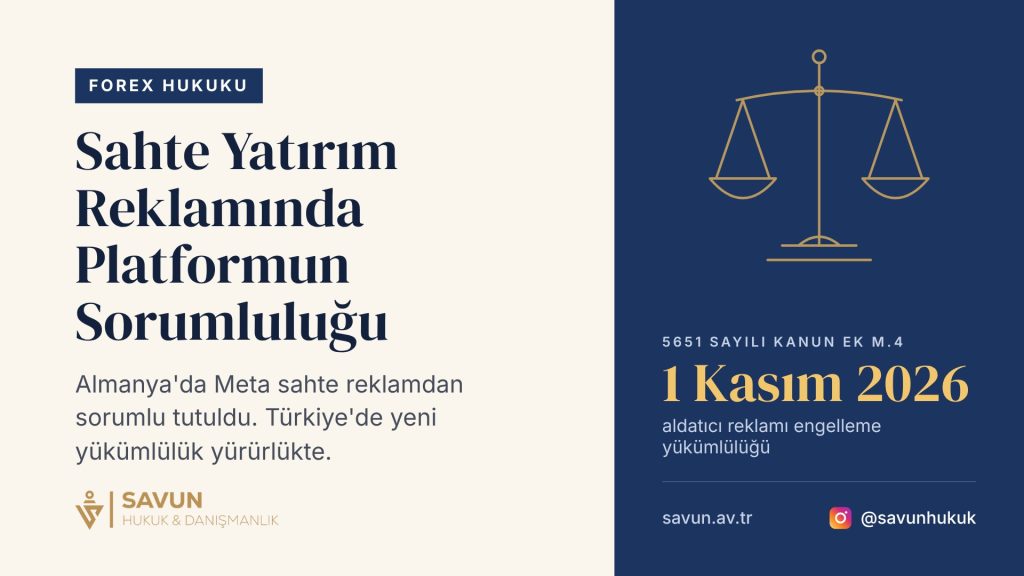
An advertisement built with the face of a well-known businessperson, presenter or financial commentator and promising "assured profit" is one of the most common entry points of investment fraud. The advertisement is published on a social network, through that network's advertising system and for a fee. That is why one question is being asked more and more often: does the platform that runs the advertisement carry legal responsibility? A decision given in Germany in September 2026 and a new obligation that entered into force in Türkiye on 1 November 2026 have begun to change the answer.
🎭 How Does a Fake Investment Advertisement Work?
The advertisement uses the photograph of a well-known person, an AI-generated video or the logo of a known institution. The person who clicks is directed to a registration form, a messaging group or straight to a fake investment platform. We described the method in detail in our article on investment advertisements using deepfakes and celebrity imagesTR.
In our own reviews, in roughly one third (30.6%) of the schemes whose first contact channel could be identified, contact was made through social media and internet advertising.
⚖️ The Frankfurt Decision: What Did the Court Say?
In its decision of 16 September 2026 (case no. 2-06 O 234/25), the 6th Civil Chamber of the Frankfurt am Main Regional Court held Meta, the operator of Facebook and Instagram, liable for fake advertisements published by third parties on these networks. According to the court's press release, the case was brought by an internet portal that publishes comparisons and consumer guides on financial topics and by the portal's publicly known founder. The fake advertisements used the portal's brand and the founder's name and image without permission.
The court ordered three obligations:
- An end to the publication and spread of the fake advertisements,
- Compensation for damage that these advertisements, including those with the same meaning, may cause in future,
- Information about the fake advertisements and the revenue obtained from them.
The core of the reasoning is this: Meta determines the ranking and timing of advertisements through an automated auction system and also steers the distribution of content in the user feed through algorithms. According to the court, this gives the platform control over the advertisement shown, so Meta cannot rely on the liability exemption that the European Union Digital Services Act grants to hosting services by saying "we did not know about the content". The press release also states that the claimants reported about 260 violations in August 2024 alone, that removing the advertisements took as long as 62 days, and that the same or similar advertisements continued to be published.
📌 The Limits of the Decision
- The decision is not final. An appeal to the Higher Regional Court of Frankfurt am Main remains open.
- The claimants are not investors. The case was brought by the company and its founder whose name and image were used without permission; the decision rests on the violation of their personality rights. Whether people who trusted the advertisement and lost money can claim compensation from the platform was not the subject of this case.
- The decision was given under German and European Union law. It does not bind courts in Türkiye; however, the reasoning on the platform's control over its advertising system offers an example for similar debates.
📜 The Platform's Obligations Under Turkish Law
In Türkiye, the subject is regulated separately in several laws:
- General rule (Law No. 5651, Article 5): A hosting provider is not obliged to monitor the content it hosts or to investigate whether there is unlawful activity; when it is notified of unlawful content through the procedure set out in the Law, it must remove it.
- Obligation to block deceptive advertisements (Law No. 5651, additional Article 4/21): Under the provision added by Law No. 7578 and in force since 1 November 2026, a social network provider is obliged to take measures that block deceptive advertisements. A social network provider that fails to comply may be fined up to three percent of its global turnover in the previous calendar year (additional Article 4/24).
- Advertisement library (Law No. 5651, additional Article 4/4): The social network provider creates and publishes on its website an advertisement library containing information such as the content of the advertisement, the advertiser, the duration of the advertisement, the target audience and the number of people reached.
- Failure to remove after a court decision (Law No. 5651, additional Article 4/14): A social network provider that, although notified of content found unlawful by a judge or court decision, does not remove it or block access within twenty-four hours is liable for the resulting damage; a prior lawsuit against the person who published the content is not required for this.
- Ban on deceptive advertising (Law No. 6502, Article 61): Commercial advertising that deceives the consumer cannot be made; advertisers, advertising agencies and media organisations are obliged to comply with these rules.
- Unauthorised investment activity (Law No. 6362, Articles 99 and 99/A): When unauthorised capital markets activity or unauthorised crypto asset services are found to be carried out over the internet, the Capital Markets Board decides to remove the content or block access.
- General liability rule (Turkish Code of Obligations, Article 49): A person who causes damage to another through a wrongful and unlawful act is obliged to compensate that damage.
Most of these provisions regulate the platform's obligations and administrative sanctions. No single article answers whether a person who lost money because of a fake advertisement can claim compensation from the platform; the answer is assessed separately in each case, according to whether the platform was notified of the advertisement, what it did after being notified, and the link between the damage and the advertisement.
🧭 What It Means for Victims
In an investment fraud that begins with a fake advertisement, the target of the criminal investigation is the people who placed the advertisement and collected the money; the act is treated as qualified fraud committed through computer systems (Article 158/1-f of the Turkish Penal Code). The account that published the advertisement, the advertisement text and the address it redirected to are evidence in the case file for identifying the advertiser; records in the advertisement library may also be used for this purpose.
For tracing and recovering the money, areas of responsibility outside the platform also come into play: the liability of banksTR and the liability of the owner of the account the money was sent to are among the first. For people whose name or image was used in an advertisement without permission, legal remedies against unauthorised use of imagesTR are a separate subject. Whether a review exists for an investment platform can be seen on the investment platform lookup page.
❓ Frequently Asked Questions
Can a social network that runs a fake investment advertisement be held liable?
Is the Frankfurt decision valid in Türkiye?
Was the Frankfurt case brought by defrauded investors?
What is an advertisement library?
Is the celebrity in a fake advertisement responsible?
I lost money because of a fake investment advertisement; what can be done?
For detailed information and legal support, you can contact Savun Law & Consultancy.

Questions & answers · Istanbul Bar Association 75235
Have a question about this topic? Ask our lawyer.
Write your question and Attorney Veli Savun will answer it on this page. You do not need to give your name.
Example questions — tap one and adapt it to your situation:
Answers are general information only; they do not create a lawyer–client relationship and are not legal advice on your specific case. All questions & answers →
Have a question? Attorney Veli Savun answersThis page is an English adaptation of our Turkish article Sahte Yatırım Reklamında Platformun Sorumluluğu: Almanya Kararı ve Türk Hukuku.
More from Investment Fraud & Crypto Law in Türkiye
- Bank Liability for Forex Pool Account: Court of Cassation Ruling
- Lawsuit Against a Dissolved Company: Istanbul Appeal Court 2025/513
- Bank Reversed a Deposit Without Consent: Court of Cassation 2023
- Recovery Scams: Warning Signs of Fake Fund Recovery Offers
- Forex Scheme Operation: How a Victim Joins the Case (2026)
- SIM Swap Fraud: Which Court Hears the Bank's Recourse Action?