
Forex Fraud: Account Holder Liability After the 12th Judicial Package
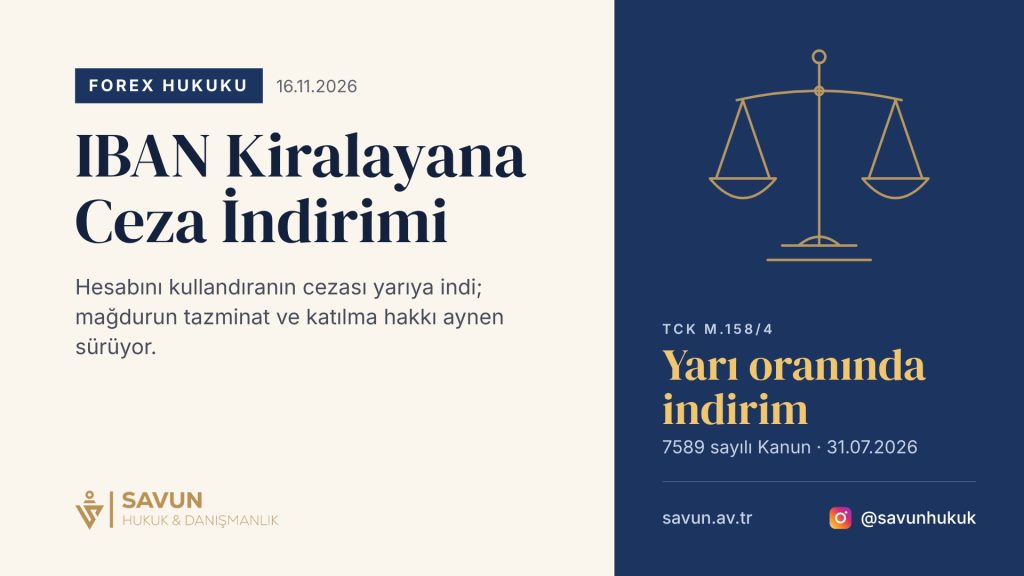
In forex and crypto fraud, the victim's money most often goes not to the platform itself but to the bank, payment institution or crypto exchange account of a third person. Law No. 7589 (publicly known as the 12th Judicial Package), which entered into force on 31 July 2026, reorganised the penalty for persons who let others use their account or card. This article looks at what the amendment brings and whether it changes the victim's options against the account holder.
⚖️ TCK Article 158/4: What Changed?
Article 13 of Law No. 7589 added the following paragraph to Article 158 of the Turkish Penal Code:
“Where participation in the offences set out in this Article and in Article 157 is limited to the act of giving to another person, with the aim of obtaining an unjustified benefit for oneself or another, payment instruments such as a bank or credit card belonging to oneself or another, or the necessary information or tools that enable the use of an account held at a bank, brokerage firm, payment service provider or crypto-asset service provider, the penalty to be imposed shall be reduced by half.”
The paragraph expressly lists not only bank accounts but also accounts at brokerage firms, payment service providers and crypto-asset service providers. The condition for the reduction is that the contribution is limited to this act. For a person who took part in persuading the victim, in moving the money on to other accounts or in organising the scheme, the condition the paragraph requires is not met. The other provisions of the package are set out article by article in our article on the 12th Judicial Package (Law No. 7589)TR.
🧭 What Changed for the Victim, and What Did Not?
| Subject | Position after 31.07.2026 |
|---|---|
| Penalty of the person who let others use their account | Changed: if the contribution is limited to giving an account or card, the penalty is reduced by half |
| The act being a crime | Unchanged: it is punished as participation in fraud |
| The victim's right to lodge a complaint and join the case | Unchanged (CMK Articles 234 and 237) |
| Compensation for the loss | Unchanged (TBK Articles 49 and 61) |
Under the Turkish Code of Obligations, when several persons jointly cause a loss, the provisions on joint and several liability apply to them (TBK Article 61). The reduction of the penalty therefore does not affect the victim's ability to direct a claim for compensation of the loss against the account holder as well; the scope of the claim is assessed according to the circumstances of each case. The civil law routes for recovering the money are covered in our articles on restitution and unjust enrichment claimsTR and on bank liabilityTR.
⏳ Pending and Finalised Cases
Provisional Article 1 of the Law introduced two separate rules for cases in which a judgment was given before the date of entry into force:
- Cases under appellate review: For defendants to whom the new paragraph will apply, a decision to quash is given in their cases at the regional court of appeal and the case is sent to the first-instance court (provisional Article 1/6).
- Cases at the enforcement stage: A convict covered by the new paragraph may benefit from the effective remorse provisions (TCK Article 168/2) if, within six months of the court's notice, the victim's loss is fully compensated. Unless the loss is fully compensated, a stay or suspension of enforcement cannot be ordered under this provision (provisional Article 1/7).
The second rule matters for the victim: in finalised cases, the account holder's ability to benefit from this possibility is made conditional on the victim's loss being fully compensated.
🏦 The Account Holder's Position Depends on Each Case
The account to which the money was transferred is the starting point for tracing the flow of money. Not every account holder is in the same position: the position of a person who knowingly let others use their account in return for a benefit differs from that of a person whose account was used without their knowledge. Liability is determined by factors such as the person's knowledge, intent and role in the flow of money. The rules on the short-term suspension of an account used in a crime are explained in our article on CMK Article 128/A.
❓ Frequently Asked Questions
Is a person who rents out an IBAN no longer punished?
Does the reduction of the penalty prevent the victim from claiming the money back?
Does it also cover people who let others use their crypto exchange account?
If my money went to the account of someone I do not know, can that person be identified?
Is the account holder always guilty?
For detailed information and legal support, you can contact Savun Law & Consultancy.

Questions & answers · Istanbul Bar Association 75235
Have a question about this topic? Ask our lawyer.
Write your question and Attorney Veli Savun will answer it on this page. You do not need to give your name.
Example questions — tap one and adapt it to your situation:
Answers are general information only; they do not create a lawyer–client relationship and are not legal advice on your specific case. All questions & answers →
Have a question? Attorney Veli Savun answersThis page is an English adaptation of our Turkish article Forex Dolandırıcılığında IBAN/Hesap Sahibinin Sorumluluğu: 12. Yargı Paketi Sonrası Ne Değişti?.
More from Investment Fraud & Crypto Law in Türkiye
- SPK Crypto Licence (KVHS) in Türkiye: Is a Platform Authorised?
- Forex Loss Above Margin: Court of Cassation 2025/3733
- Forex Stop-Out and Spread Claim: Court of Cassation 2025/4543
- Telegram Share Transfer Case: Sakarya Court of Appeal 2026/461
- Brokerage Liability for Leveraged Trading Loss: Court of Cassation
- Cloned Investment Site Access Ban Denied: Istanbul 2025/788