
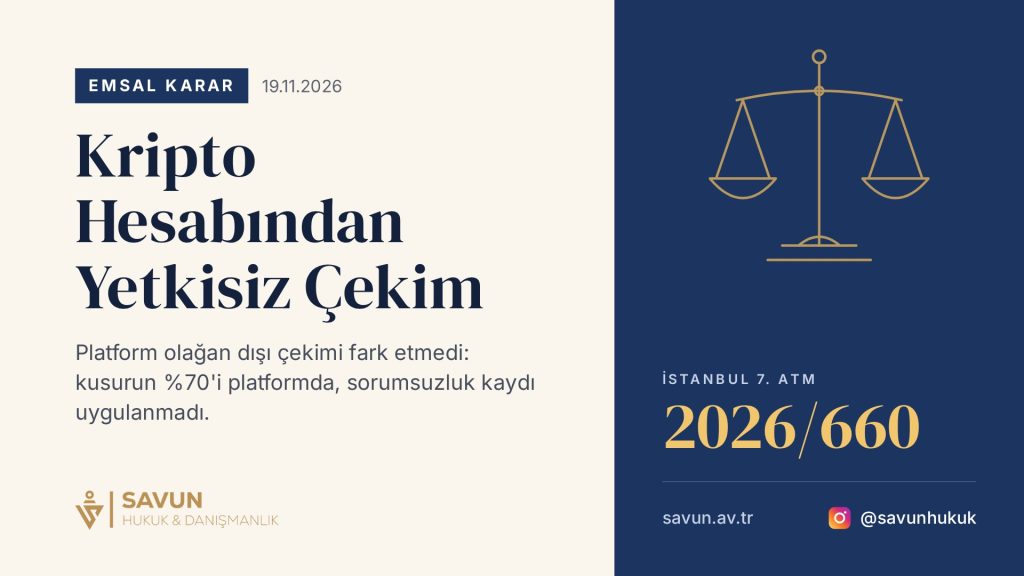
Unauthorised Crypto Withdrawal: Court Splits Fault 70/30
At 12:12 every crypto asset in the account starts being sold, at 12:13 a "new withdrawal address added" message reaches the phone, and by 12:16 the entire balance has gone to an unknown wallet. The user has only two or three minutes in which to notice what is happening and stop it. In such a picture, who should bear the loss: the user who let someone get hold of the password and verification code, or the crypto asset platform that did not stop such an unusual series of transactions? The Istanbul 7th Commercial Court of First Instance answered this question not on an "all or nothing" basis but by sharing the fault.
In its decision dated 30.09.2026, Docket No. E.2026/301, Decision No. K.2026/660, the Istanbul 7th Commercial Court of First Instance accepted that the platform had breached its duty of care because of a weakness in its security system, found that the user had also contributed to the loss, divided the fault as 70% platform, 30% user and partially upheld the claim.
- What the log records show minute by minute
- The user's claim and the platform's defence
- The ruling: what was decided, and for how much
- The nature of the user agreement
- Why the exclusion clause did not work
- The unusual transaction pattern and e-mail confirmation
- The user's share: a thirty per cent reduction
- Comparison with similar decisions
- Frequently Asked Questions
⏱️ What the Log Records Show Minute by Minute
The fate of the case was determined by the expert panel report dated 01.07.2024, which the court commissioned, and the log records the platform submitted to the case file. According to these findings, which the court found "suitable for review and sufficient to base a judgment on", the sequence of events is as follows:
- 08.05.2023, 21:26: The claimant's account was logged into with the correct username, password and SMS code, from an IP address abroad and through the browser of a social media application. The device verification code was sent by e-mail and entered.
- In the same session: The user confirmation method was changed, the registered device in the account was deleted and the confirmation mechanism for market sell orders was switched off.
- 09.05.2023, 12:12:51 – 12:14:09: All assets in the account were sold and TRX was bought.
- 12:13 and 12:14: SMS messages informing the claimant that "a new address has been added to your account" were sent. The new wallet address was verified by e-mail confirmation only.
- 12:16: 78,411.16 TRX was withdrawn to the newly defined address, and the SMS notifying that the withdrawal had taken place was sent at this time.
The experts found nothing linking the claimant to these transactions; they calculated the loss as TRY 111,924.09 using the unit price of TRY 1.4274 on the date of the event. The amount claimed in the enforcement proceedings, by contrast, is TRY 215,000.
🗂️ The User's Claim and the Platform's Defence
The claimant argued that an address was added to the account without consent and that, because of a security weakness at the platform, the money in the account was transferred to unknown persons. In the claimant's view, the platform, as a prudent merchant, is obliged to take the necessary measures against digital attacks, and the two-to-three-minute gap between the warning message and the withdrawal left no opportunity to take any measure. The claimant sought annulment of the objection to the enforcement proceedings and enforcement denial compensation of not less than 20% of the principal receivable. The compulsory mediation talks before the case ended without agreement.
The platform told a completely different story: the claimant clicked a fake link on the internet and shared the account details and confirmation codes with third parties, so the loss arose through the claimant's own gross fault. The platform is not a bank and acts only as an intermediary; the log records show that all passwords were entered correctly, and a 12-hour crypto withdrawal block is applied after a device change. The platform also stressed that the claimant had used the platform "like a professional investor" since 08.03.2021 and requested bad-faith compensation.
🏛️ The Ruling: What Was Decided, and for How Much
- The claim was partially upheld, the objection was annulled in respect of a principal receivable of TRY 78,346.86, and the enforcement proceedings continue for that amount with statutory interest from the date of the proceedings,
- The request for the excess was rejected,
- Because the receivable is not liquid, the request for enforcement denial compensation was rejected,
- A decision and judgment fee of TRY 5,351.87 is to be collected from the defendant,
- A fixed attorney's fee of TRY 45,000.00 was awarded in favour of each party,
- Of the claimant's litigation costs of TRY 11,622.00, TRY 4,235.10 is to be collected from the defendant according to the ratio of acceptance to rejection (36.44%).
The decision was issued as open to appeal within two weeks of notification.
📑 The Nature of the User Agreement
Before entering the fault discussion, the court characterised the relationship between the parties. The user agreement was accepted as an agreement that places on the platform the obligation to intermediate in crypto asset trading on the user's behalf and to safeguard the assets in the account, and to which the provisions on the mandate (agency) contract apply. The consequences of this characterisation are gathered under three headings:
- Article 18/2 of the Turkish Commercial Code (TTK): A platform that makes this activity its profession and earns income from it must act as a prudent merchant.
- Article 506 TBK: As the agent, it is obliged to carry out the work with care; according to the court, this also includes taking "every measure that technology allows" for the security of customer accounts.
- Article 112 TBK: A debtor is obliged to compensate the loss arising from breach of the obligation unless it proves that no fault can be attributed to it. The burden of proof lies on the platform, which must prove it was not at fault.
🚫 Why the Exclusion Clause Did Not Work
The user agreement contains a provision under which the platform is not liable in cases of cyber security breaches and fraud. The court set this clause aside on two separate grounds.
The first is interpretation: By its wording, the provision concerns risks that may arise on the platform and network to which the crypto asset belongs; it does not cover the platform's liability arising from a weakness in its own account security system. Moreover, as this provision prepared in advance by the platform is a general term and condition, it is interpreted against the party who drafted it under Article 23 TBK.
The second is absolute nullity: Under Article 115/1 TBK, advance agreements that the debtor will not be liable for its gross fault are absolutely void. The platform therefore could not escape liability by relying on that provision.
🚨 The Unusual Transaction Pattern and E-mail Confirmation
The court treated as decisive not a single shortcoming but the fact that successive warning signs were overlooked together:
- The account was accessed from an IP address abroad and through a social media browser,
- The registered device was deleted, the authentication method was changed and the order confirmation mechanism was switched off,
- All assets in the account were sold within minutes and transferred to a newly defined wallet address,
- Despite this, the system did not flag the transaction as suspicious.
In addition, it was established that the definition of the new wallet address and the withdrawal confirmation were verified by e-mail only, while the SMS was used for information purposes only. In the two-to-three-minute period between the address-adding notice and the withdrawal, the claimant had in practice no opportunity to intervene. From these facts the court concluded that the withdrawal, which was decisive in causing the loss, took place because of a weakness in the platform's security system and that the platform acted in breach of its contractual duty of care.
⚖️ The User's Share: A Thirty Per Cent Reduction
The court did not accept the platform's defence that "the user's gross fault broke the causal link", but it also did not treat the user as entirely free of fault. According to the reasoning, the claimant left the account details and SMS verification code open to access by third parties; despite the notification of a login from a new device on 08.05.2023, the claimant did not inform the platform for about 15 hours and did not use the opportunity to prevent the loss during the 12-hour block period. This conduct was not seen as weighty enough to break the causal link, but was accepted as having contributed to the loss.
Three criteria were considered together in setting the fault ratio: the degree of each party's duty of care, the fact that the platform is the only party able to control the risk, and the effect of the faults on the occurrence of the loss. In the end the platform was found 70% and the user 30% at fault, and a 30% reduction was made from the compensation under Article 52 TBK. The calculation is simple: 70% of the TRY 111,924.09 loss is TRY 78,346.86.
The rejection of the claim for enforcement denial compensation is a continuation of the same logic. Because the existence and amount of the receivable could be determined only through an assessment of fault and an expert examination, the court did not regard the receivable as liquid. The platform's request for bad-faith compensation, for its part, found no separate answer in the ruling.
🔎 Comparison with Similar Decisions
The liability of crypto platforms for account security has led to different outcomes in decisions previously reviewed on this site. In the case discussed in the article on phishing loss in crypto, the experts found no unusual IP movement and no technical security gap, and the compensation claim was dismissed. In the decision in the article on USDT sent to a fake platform, the transfers had been approved by the user personally, and no causal link could be established between the platform and the loss.
What sets this decision apart from them is that the attack was carried out without the user's approval and that the log records clearly show a pattern the platform's system could be expected to notice. Not every transaction made with the correct password and code automatically relieved the platform of liability, while the user's failure to protect their details reduced the compensation.
❓ Frequently Asked Questions
Can a platform be held liable for a withdrawal made with the correct password and SMS code?
Is the clause in the user agreement saying "we are not liable for cyber attacks" valid?
How did the user's fault affect the compensation?
Why was the whole claimed amount not accepted, and why was enforcement denial compensation rejected?
For detailed information and legal support, you can contact Savun Law & Consultancy. The contact details are available on the contact page, and other decisions on crypto asset disputes are listed on the Precedent DecisionsTR page.
This article is for general information only; its content is compiled from the first-instance decision of the Istanbul 7th Commercial Court of First Instance published in the official decision database. Party and platform names are anonymised in the decision text. Amounts and times are reported as they appear in the decision text and the expert findings. The decision was issued as open to appeal, and a higher court may reach a different result. In a case that looks similar, the outcome may differ depending on the log records, the platform's security architecture, the user's conduct and the court's assessment of fault. Savun Law & Consultancy cannot be held responsible for any application, lawsuit or defence made on the basis of this article.

Questions & answers · Istanbul Bar Association 75235
Have a question about this topic? Ask our lawyer.
Write your question and Attorney Veli Savun will answer it on this page. You do not need to give your name.
Example questions — tap one and adapt it to your situation:
Answers are general information only; they do not create a lawyer–client relationship and are not legal advice on your specific case. All questions & answers →
Have a question? Attorney Veli Savun answersThis page is an English adaptation of our Turkish article Kripto Hesabından Yetkisiz Çekim – İstanbul 7. ATM 2026/660.
More from Investment Fraud & Crypto Law in Türkiye
- Fake Investment Platform USDT: Crypto Exchange Liability Ruling
- Crypto Token Screen Value Is Not a Claim: Istanbul Court 2026
- Tera Yatırım Licence Revoked: Investor Rights Explained
- Crypto Platform Sues User: Consumer Court Jurisdiction Ruling
- Negative Oil Price Stop-Out Ruling: Istanbul Appeal Court 2025
- Fraud Claim and Attachment: Ankara Appeal Court Ruling 2026/563