
Where to Report Crypto Fraud in Türkiye: Complaint Channels 2026
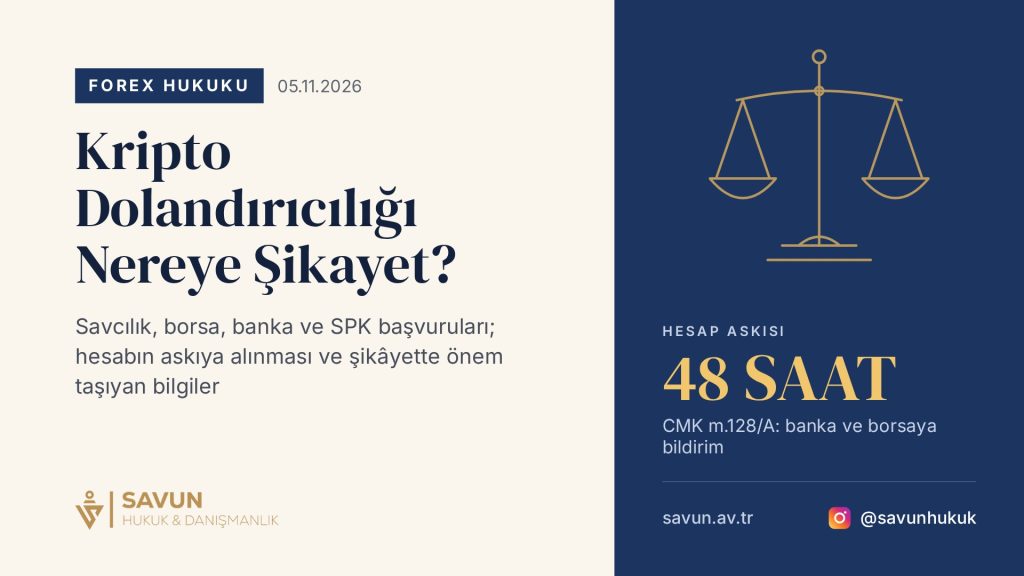
Where to report crypto fraud is a question usually asked in the first hours after money leaves a wallet or a crypto exchange, and the speed of the answer directly affects the outcome. The most common schemes are "analysis" referrals in Telegram or WhatsApp groups, fake exchange or wallet apps, and triangular fraud in P2P (peer-to-peer) USDT trading. This article explains the reporting channels, the information that matters in a complaint, the 48-hour account suspension mechanism, the legal classification of the offence, the competent court and the process that follows, using the current legislation. Where the technical and legal sides of a case have to be handled together, working with a crypto asset lawyerTR helps the evidence enter the case file correctly from day one.
- Where is crypto fraud reported? Table of reporting channels
- The first hours: 48-hour account suspension (CMK Art. 128/A)
- Which information matters in a crypto fraud complaint?
- Triangular fraud in P2P and USDT trading, and account freezes
- Which offence is crypto fraud? Penalty and competent court
- Reports to SPK: unauthorised crypto asset services
- The investigation process after a complaint
- Warning about recovery (fund recovery) scams
- Frequently Asked Questions
🏛️ Where Is Crypto Fraud Reported? Table of Reporting Channels
There is no single "crypto complaint hotline" for crypto victims; some channels only pass on information, while others can act directly on the account. The table summarises what each route achieves.
| Channel | Basis | What it provides | Limit |
|---|---|---|---|
| Chief Public Prosecutor's Office or law enforcement (police, gendarmerie) | CMK Art. 158/1, 158/5 | The start of an investigation, a request for account information, a request for seizure | On an abstract and general complaint, a decision that there is no ground to investigate may be given (Art. 158/6) |
| Türkiye's embassies and consulates | CMK Art. 158/3 | A victim living abroad can report a crime that must be pursued in Türkiye | The complaint is forwarded to the relevant prosecutor's office and processed there |
| The licensed Turkish crypto platform the money reached | Capital Markets Law Art. 35/C/1; CMK Art. 128/A | An internal complaint mechanism; suspension of the account used in the crime for up to 48 hours | The suspension period is short; seizure requires a judge's decision or a prosecutor's order |
| The bank or payment institution the money was sent to | CMK Art. 128/A | Suspension of the recipient account and notification to the prosecutor's office | If the money has moved to another institution, notice is given to that institution (Art. 128/A-3) |
| SPK | Capital Markets Law Art. 99/A, 109/A; Petition Rights Law No. 3071 | An access ban on an unauthorised platform, administrative measures, a criminal complaint | The SPK review is a compliance check; it does not decide on compensation for the loss |
| MASAK | Law No. 5549 Art. 4, 19/A | Suspicious transaction reports by obliged institutions; postponement of a transaction where laundering is suspected | It is not an authority that refunds victims and does not replace a criminal investigation |
| USOM | Cyber reporting procedures (usom.gov.tr) | Reporting of phishing (fake site) links | It does not identify perpetrators or provide a refund |
| CİMER | Right of petition | Forwarding of the complaint to the relevant institution | It does not conduct investigations |
In short, the centre of the question of where crypto fraud is reported is the prosecutor's office: investigating the crime and seizing the account is possible only through criminal procedure; reports to SPK, MASAK and USOM support that process. The general framework of the crypto fraud complaint process, together with other types of fraud, is also covered in our article on what happens after being defrauded.
Can a crypto complaint be made through e-Devlet or UYAP?
Under the Ministry of Justice heading on the e-Devlet (e-Government) Gateway, there are case and enforcement file query services through the UYAP Citizen Portal login; there is no separate service on this list called "criminal complaint to the prosecutor's office". In practice, the petition is handed in person to the prosecutor's office, made orally to law enforcement and recorded in a report, or sent by an authorised lawyer through the UYAP Lawyer Portal. SPK's "e-Application (Individual)" service is listed on e-Devlet; the institution can also be reached by a written application and registered electronic mail (KEP) under the Petition Rights Law No. 3071.
⚡ The First Hours: 48-Hour Account Suspension (CMK Art. 128/A)
Article 128/A, added to the CMK by Law No. 7571 of 24.12.2025, is the provision that can produce the fastest result in crypto fraud. Accordingly, where there is reasonable suspicion that aggravated theft using information systems (TCK Art. 142/2-e), qualified fraud (TCK Art. 158/1-f and l) or misuse of bank or credit cards (TCK Art. 245) has been committed, a bank, payment service provider or crypto asset service provider may suspend the account used in the crime for up to forty-eight hours.
- The suspension and the account movements are reported immediately to the Chief Public Prosecutor's Office; the account holder can apply for it to be lifted, and the prosecutor decides within twenty-four hours (Art. 128/A-2).
- If the money was transferred to another financial institution before the suspension was completed, the first institution notifies that institution without delay (Art. 128/A-3).
- The suspended funds can be seized by a judge's decision, or by the prosecutor's written order where delay would be harmful; the prosecutor's order is submitted to the judge for approval within twenty-four hours, and if the judge does not decide within forty-eight hours, the seizure lapses automatically (Art. 128/A-4).
- If the seized funds are found to belong to the victim, they are returned to the owner during the investigation or prosecution stage (Art. 128/A-5).
Because the periods are short, in practice it can be decisive for the notification to the exchange or bank and the complaint to the prosecutor's office to be made on the same day. If the assets have moved to an exchange abroad or to a personal wallet, this mechanism cannot be applied directly; at that stage, on-chain tracing becomes important. This topic is explained in detail in our article on how stolen crypto can be recoveredTR.
🧾 Which Information Matters in a Crypto Fraud Complaint?
CMK Art. 158/6 provides that a decision not to investigate may be given for abstract and general complaints. In crypto cases, saying "I was defrauded" is not enough; the technical data matters in the petition so that the prosecutor's office can decide which institution to write to and what to ask.
- Wallet addresses: the address the victim sent from and the deposit address given by the fraudster.
- TxID / transaction hash: the unique identifier of each transfer on the blockchain, together with the network (for example TRC-20, ERC-20, BEP-20).
- Date and time: blockchain records often show UTC time; stating the difference from Türkiye time avoids confusion.
- Exchange account details: the user number, transaction history and withdrawal records on the Turkish platform.
- Bank receipts: if TL was sent, receipts showing the recipient's name and IBAN (especially in P2P transactions).
- Correspondence: WhatsApp, Telegram or e-mail messages, the group name and invitation link, usernames and telephone numbers.
- Site and app details: the domain name and app name of the fake platform, and screenshots.
Messages that are preserved without deletion and screenshots that are stored with their dates are valuable for the digital examination carried out by law enforcement. A sample petition that presents this data in an orderly table is included in our article on the criminal complaint petition for crypto fraudTR.
🔄 Triangular Fraud in P2P and USDT Trading, and Account Freezes
In the triangular scheme, also known as crypto swap fraud, there are three parties: the person selling USDT through a P2P listing, the fraudster who "buys" this USDT, and a third person whom the fraudster persuades, on another pretext (an advert, a house for rent, a car deposit, an investment promise), to send money. The third person sends the money directly to the USDT seller's IBAN; when the seller sees the payment arrive, he releases the USDT to the fraudster's account. When the real victim complains, the recipient shown at the bank is the USDT seller; a freeze can be placed on this person's account and he can be called to give a statement as a suspect.
Two different positions therefore arise in USDT complaint processes: the victim who received nothing in return, and the seller who says he sold in good faith and whose account has been frozen. For both, in-platform messages and the transaction ID are decisive. Detailed scenarios are described in our article on P2P crypto trading fraudTR.
The fourth paragraph added to TCK Art. 158 by Law No. 7589 of 16.07.2026 provides that, where participation in the fraud is limited to giving another person, for unjust gain, a payment instrument such as a bank card belonging to oneself or another, or the information that enables the use of an account held at a bank, brokerage firm, payment service provider or crypto asset service provider, the penalty is reduced by half. The provision matters in crypto frauds carried out through "account renting". In cases where the money was sent through a bank, the bank's duty of care can also be assessed; this topic is examined in our article on bank liability in investment fraudTR.
⚖️ Which Offence Is Crypto Fraud? Penalty and Competent Court
Crypto fraud is not regulated as a separate offence in the TCK; different articles apply depending on how the act was carried out. The deciding criterion is whether the victim made the transfer of his own will after being deceived, or whether the perpetrator made the transfer himself with the information he obtained.
| Act | Article | Penalty (text of the provision) |
|---|---|---|
| Deception through fraudulent conduct (basic form) | TCK Art. 157 | 1-5 years' imprisonment and a judicial fine of up to 5,000 days |
| Deception using information systems such as a fake platform, app or messaging group, or a bank, as a tool | TCK Art. 158/1-f | 4-10 years' imprisonment; the judicial fine cannot be less than twice the benefit obtained from the crime |
| Posing as an employee of a bank, insurance or credit institution, or as a public official | TCK Art. 158/1-l | 4-10 years' imprisonment; the same minimum for the judicial fine |
| Committed by three or more people or as part of an organisation's activity | TCK Art. 158/3 | The penalty is increased by half; doubled within an organisation |
| The perpetrator makes the transfer personally with an obtained password or recovery words | TCK Art. 142/2-e | 5-10 years' imprisonment |
| Obtaining a benefit by altering data in an information system (if no other offence arises) | TCK Art. 244/4 | 2-6 years' imprisonment and a judicial fine of up to 5,000 days |
| Operating as a crypto asset service provider without permission | Capital Markets Law Art. 109/A | 3-5 years' imprisonment and a judicial fine of 5,000-10,000 days |
Since most crypto cases take the form of making someone deposit money into a fake platform with an investment promise, they are assessed under TCK Art. 158/1-f. For the details of the distinction, see our articles on qualified fraudTR and fraud through information systems.
Competent court, limitation period and reconciliation
Qualified fraud was removed by Law No. 7571 from the list of offences within the jurisdiction of the heavy penal court under Article 12 of Law No. 5235. For this reason, in newly filed cases the criminal court of first instance is competent unless the upper limit of the penalty exceeds ten years; in the aggravated cases of Art. 158/3, where the upper limit exceeds ten years, the jurisdiction of the heavy penal court may come into play. Cases already pending before heavy penal courts on the date of the amendment continue to be heard under the old jurisdiction rules (Law No. 5235, provisional Art. 7). The limitation period for the prosecution is fifteen years for Art. 158, whose upper limit is ten years, and eight years for Art. 157 (TCK Art. 66/1-d, e). Basic fraud (Art. 157) falls within reconciliation; qualified fraud does not (CMK Art. 253). If the perpetrator fully compensates the loss before the prosecution begins, up to two thirds of the penalty may be reduced; for partial compensation, the victim's consent is required (TCK Art. 168).
🏢 Reporting Crypto Fraud to SPK: Unauthorised Crypto Asset Services
Article 35/B, added to the Capital Markets Law by Law No. 7518 of 26.06.2024, makes it mandatory to obtain permission from SPK for crypto asset service providers to be established and to start operating. Article 35/C imposes on platforms the duty to set up internal mechanisms that resolve customer complaints effectively and to identify customers under Law No. 5549. On SPK's page for crypto asset service providers, the "List of Operating Providers" and the "List of Providers in Liquidation" are published separately (SPK – Crypto Asset Service Providers).
Under Capital Markets Law Art. 99/A, a platform established abroad that operates towards persons resident in Türkiye is also regarded as an unauthorised crypto asset service provider; opening a Turkish-language website or advertising in Türkiye is accepted as an indicator of such targeting. Where it is found that the unauthorised activity is carried out over the internet, SPK issues an access ban decision and sends it to the Association of Access Providers (Art. 99/A-3). However, as stated on SPK's official complaint page, the Board's review is a compliance check and no decision is made on compensation for losses (SPK – Complaint Application). The content and channels of the application are explained in our article on complaints to SPK, and how to tell whether a platform is licensed is explained in our article on how to recognise an SPK-licensed crypto exchange.
🔍 After a Crypto Fraud Complaint: The Investigation Process
When the complaint reaches the prosecutor's office, the public prosecutor starts investigating the truth of the matter under CMK Art. 160. Typical steps are requesting account movements from banks and Turkish crypto platforms, identifying wallet and telephone users, an expert examination and a seizure request. Under CMK Art. 128/A-7, a bank, payment service provider and crypto asset service provider must send within ten days the information and documents requested by the prosecutor's office, judge or court; an institution that fails to do so is given an administrative fine.
If sufficient suspicion does not arise at the end of the investigation, a decision of non-prosecution is given. A person harmed by the crime can object within two weeks of notification of this decision to the criminal judgeship of peace (CMK Art. 173/1); the judgeship may, if necessary, ask for the investigation to be widened (Art. 173/3). The structure of an objection petition is in our article on a sample petition objecting to a non-prosecution decisionTR.
Court of Cassation 11th Criminal Chamber 2026/1903: crypto investment through Telegram
In its decision of 23.02.2026, Docket No. E.2025/4373, Decision No. K.2026/1903, quashing in the interest of the law, the 11th Criminal Chamber of the Court of Cassation reviewed the case of a victim who was made to buy fake tokens after trust was gained through an "analysis group" and small bonuses on Telegram, and whose web3 wallet was then emptied. The Chief Public Prosecutor's Office had issued a non-prosecution decision on the grounds that the victim followed the instructions willingly and did not meet the duty to investigate, and the objection had also been rejected. The Chamber stated that the identity of the suspects should be established, bank account movements obtained, the relevant crypto platforms written to, and the Cyber Crime Combating Department of the General Directorate of Security asked about similar acts, and it quashed the rejection of the objection, which rested on an incomplete investigation. A detailed review of the decision is in our article on non-prosecution in a Telegram crypto investment – Court of Cassation 11th Criminal Chamber 2026/1903TR.
Alongside the criminal investigation, compensation and precautionary attachment routes may also arise before a civil court; working with a fraud lawyerTR in running these two dimensions together makes it easier to follow the time limits and the seizure requests.
🚨 Warning About Recovery (Fund Recovery) Scams
The most common scheme in which crypto victims suffer a second loss is made up of persons and sites promising "fund recovery", "blockchain analysis" or "recovery" services. These operations usually approach the victim themselves, present themselves as an official body or a cyber security firm, and say "your money has been found, a fee must be paid for the withdrawal". In the case that is the subject of Decision 2026/1903 mentioned above, too, the victim is alleged to have sent money a second time on the promise that the lost money could be recovered.
The power of seizure and return belongs only to judicial authorities; those who promise "recovery" in return for payment have no such power. Examples of the scheme are described in our article on recovery scams (fund recovery fraud)TR.
❓ Frequently Asked Questions
Where is crypto fraud reported?
A crypto fraud complaint can be made, in writing or orally, to the Chief Public Prosecutor's Office or to law enforcement (CMK Art. 158). If the money went to a bank or a licensed crypto platform in Türkiye, notifying that institution can lead to the account being suspended for up to 48 hours (CMK Art. 128/A). Unauthorised platforms can also be reported to SPK.
I have been defrauded in crypto. What can be done?
The most important element at this stage is time: when the notification to the bank or platform and the complaint to the prosecutor's office are made on the same day, the suspension mechanism can be applied. Wallet addresses, TxIDs and receipts make the complaint concrete. For detailed information and legal support, you can contact Savun Law & Consultancy.
What can crypto victims do, and is a joint complaint possible?
Victims defrauded by the same platform or group can each file a complaint, and the cases can be joined. Decision 2026/1903 of the 11th Criminal Chamber of the Court of Cassation also stressed that similar acts across the country should be investigated.
I was defrauded in bitcoin. Is a bitcoin fraud complaint different?
No; a complaint about bitcoin, USDT or any other coin fraud goes to the same authorities. The difference lies in the technical data: in USDT transactions, the network used (such as TRC-20 or ERC-20) is stated alongside the transaction hash.
I was defrauded through an exchange or wallet such as Binance or MetaMask. Who is the complaint directed at?
In most cases the exchange or wallet app is only the tool through which the transfer was made; the complaint is made about the person or persons who carried out the deception. The platform the money passed through is named in the petition as the institution the prosecutor's office will request information from; with platforms abroad, the process may take longer because of judicial assistance.
How is crypto fraud carried out over WhatsApp reported?
Crypto investment fraud run through WhatsApp or Telegram is also generally assessed under TCK Art. 158/1-f because information systems are used as a tool. The group name, telephone numbers, invitation link and messages matter in the complaint.
My account was frozen in a crypto swap (P2P) fraud. What happens?
In triangular fraud, because the victim's money arrived in the account of the person selling USDT, a freeze can be placed and the seller can be heard as a suspect. The transaction record and messages on the P2P platform are decisive in showing good faith; if the account is suspended, the account holder can apply to the prosecutor's office to have it lifted (CMK Art. 128/A-2).
What is the penalty for crypto fraud?
For qualified fraud committed using information systems, the penalty is 4 to 10 years' imprisonment, and the judicial fine cannot be less than twice the benefit obtained from the crime (TCK Art. 158/1-f). If the offence is committed by three or more people the penalty is increased by half, and if committed within an organisation it is doubled (Art. 158/3).
Which court hears a crypto fraud case?
After the amendment made by Law No. 7571, qualified fraud cases are heard by the criminal court of first instance unless the upper limit of the penalty exceeds ten years. If aggravating circumstances such as an organisation raise the upper limit above ten years, the heavy penal court may be competent. Cases filed before the amendment in the heavy penal court continue there.
Is there a time limit for a crypto fraud complaint?
Qualified fraud does not depend on a complaint; the prosecutor's office investigates of its own motion, and the limitation period for the prosecution is fifteen years (TCK Art. 66/1-d). However, account suspension periods are very short; delay can cause the trail of the money to be lost.
Does SPK refund my money in a crypto fraud?
No. SPK can issue access bans, take administrative measures and file criminal complaints; however, according to its official statement, it does not decide on compensation for losses. A refund arises through seizure in the criminal investigation or compensation before a civil court.
What can be done if a non-prosecution decision is given?
An objection can be made to the criminal judgeship of peace within two weeks of notification of the decision of non-prosecution (CMK Art. 173/1). The Court of Cassation has more than once quashed, in the interest of the law, the rejection of objections to non-prosecution decisions given in crypto cases without examining account movements and platform records.
As much as the answer to where crypto fraud is reported, reaching the right authority quickly and with the right data is decisive for the money's trail to be followed. For detailed information and legal support, you can contact Savun Law & Consultancy.

Questions & answers · Istanbul Bar Association 75235
Have a question about this topic? Ask our lawyer.
Write your question and Attorney Veli Savun will answer it on this page. You do not need to give your name.
Example questions — tap one and adapt it to your situation:
Answers are general information only; they do not create a lawyer–client relationship and are not legal advice on your specific case. All questions & answers →
Have a question? Attorney Veli Savun answersThis page is an English adaptation of our Turkish article Kripto Dolandırıcılığı Nereye Şikayet Edilir? 2026 Başvuru Yolları.
More from Investment Fraud & Crypto Law in Türkiye
- SPK Complaint in Türkiye: Channels, Process and Limits
- Cash Handed to a Brokerage Employee: Court of Cassation 2022/820
- Can Investors Sue SPK for Forex Losses? Council of State Ruling
- Forex Robot Allegation: Istanbul Appeal Court Ruling 2025/1669
- Forex Profit Cancelled: Council of State 13th Chamber 2025/92
- Deepfake Celebrity Ad Investment Scam Explained