
Inheritance Certificate Without Apostille: Court of Cassation 2026
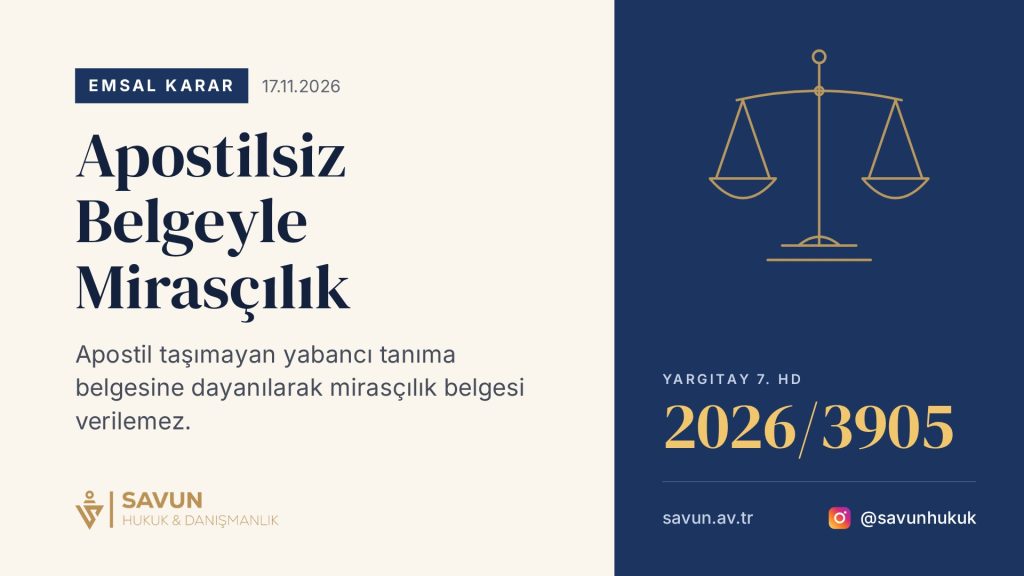
Who the heirs are can often be seen in a few minutes by looking at the population registers. But the picture changes when one branch of the family tree lives abroad or was formed under the law of another country. A recognition certificate, birth record or marriage certificate issued in a foreign country can become the cornerstone of a certificate of inheritance in Türkiye. The formal requirements under which such a document counts as an "official document" before a Turkish court directly decide who receives the estate. The 7th Civil Chamber of the Court of Cassation examined this question in an inheritance certificate based on an acknowledgement of paternity made in France, and stated clearly that heirs cannot be determined on the basis of a document without an authentication certificate (apostille).
By its decision of 14.09.2026, Docket No. (E.) 2026/4196, Decision No. (K.) 2026/3905, the 7th Civil Chamber of the Court of Cassation set aside the decision of the 49th Civil Chamber of the Istanbul Regional Court of Appeal, which had dismissed an action to cancel the certificate of inheritance, and also reversed the first instance court decision. The decision was unanimous and final.
🧭 The question the decision answers
A single document lies at the centre of the dispute: a recognition document showing that the deceased's father acknowledged his child born out of wedlock in 1930 under French law in 1936. If this document is valid, the acknowledged child is a half-brother of the deceased on the father's side, and his children take the whole estate as heirs of the second parentelic group. If the document does not have the character of an official document before a Turkish court, the question whether there are heirs in the second group must be investigated again, and the claim of the relatives on the mother's side must be seriously assessed.
In short, the question was this: can a recognition document issued in a foreign country and not entered in the Turkish population register be used as the basis of a certificate of inheritance without carrying an authentication certificate? The answer of the Court of Cassation is no.
🌳 The family picture in the case and the two branches
According to the text of the decision, the Istanbul 18th Civil Court of Peace, by an inheritance certificate with Docket No. 2008/66 and Decision No. 2012/21, accepted the children of a half-brother of the deceased on the father's side as the sole heirs as heirs of the paternal branch and treated the whole estate as belonging to these two persons. The defendants argued that the deceased's father had acknowledged his child born out of wedlock in France in 1936 and that the deceased and that child were therefore half-brothers on the father's side.
The claimant and the main intervening parties are relatives of the deceased on the mother's side. Their claims are gathered around the following points:
- The recognition document was not entered in the population register of the Republic of Türkiye and its validity is disputed.
- The original of the document is not in the case file; the document carries no authentication certificate.
- The power of attorney and the translation relating to the document contain contradictory information.
- The deceased's heirs are the grandmothers and grandfathers and their descendants; that is, there are heirs on the maternal branch as well.
This picture directly concerns the parentelic system of the Turkish Civil Code. Under Article 496 of the Civil Code, the heirs of a deceased without descendants are the mother and father; those who died before the mother and father are replaced by their own descendants. The half-brother of the deceased on the father's side and his children fall within this second group. The third group in Article 497 (grandmothers and grandfathers and their descendants) is called to the estate only when there is no heir at all in the second group. For this reason the validity of the recognition document has become a fact that alone determines the outcome of the dispute between the two branches.
🏛️ The reasoning of the lower courts
The Istanbul 7th Court of First Instance in Civil Matters (2013/199 E., 2020/451 K.) dismissed the action. According to the court, there is an international agreement ensuring the international validity of the recognition document; because the document is not a final court judgment, it does not need recognition and enforcement; and even if the agreement entered into force after the document was issued, it is in force on the date the document is used.
The 49th Civil Chamber of the Istanbul Regional Court of Appeal (2023/3748 E., 2024/199 K.) dismissed the appeal on the merits. The regional court of appeal looked at the matter through the parentelic system; it accepted that the children of the half-brother acknowledged by the deceased's father are heirs of the second group, that because there are heirs in the second group the estate does not pass to the third group, and that therefore the relatives on the mother's side cannot be heirs.
Both lower courts took the validity of the recognition document as given, without separately questioning the document as to its form. The intervention of the Court of Cassation is directed exactly at this point.
⚖️ The Court of Cassation's assessment: an apostille is required
The Chamber described the dispute as a "request for cancellation of the certificate of inheritance and issuance of a new certificate" and built its assessment in four steps.
The first step is Article 224 of the Code of Civil Procedure. Under this provision, official documents prepared by the authorities of a foreign state keep that character in Türkiye only if the document is approved by the competent authority of the state that issued it or by the relevant Turkish consular authority. The provisions of international conventions to which Türkiye is a party on the authentication of foreign official documents are reserved.
The second step is the 1961 Hague Convention. This convention, which abolished the requirement of legalisation of foreign official documents, removed the obligation of diplomatic and consular approval; in its place, however, it made it compulsory that the signature on the document, the capacity of the signatory and, where necessary, the seal and stamp be certified by the competent authority of the country that issued the document, that is, that the document carry an authentication certificate.
The third step is the parties to the convention. According to the Chamber, France and Türkiye are parties to the convention. Under Articles 3, 4 and 5 of the convention, the authentication certificate is placed on the document itself or on a sheet attached to it, and confirms the authenticity of the signature, the capacity of the signatory and the conformity of the seal and stamp. Whether the copy submitted to the case file can be regarded as "the original of the document" depends on the existence of this certificate. In the words of the decision, the absence of an authentication certificate removes the reliability of the document submitted.
The fourth step is the case itself. In the inheritance certificate whose cancellation was sought, documents containing no authentication were accepted as valid and the heirs and their shares were determined. The lower courts also dismissed the action by treating the same documents as valid. The Chamber did not find this approach appropriate.
🔏 What is an apostille and what does it confirm?
An apostille is the standard authentication certificate that allows an official document issued in a state party to the Hague Convention to be used in another party state without consular approval. What matters is that the apostille verifies not the content of the document but its source. As emphasised in the decision, the certificate confirms the following three points:
- That the signature on the document is genuine,
- In what official capacity the person who signed the document signed it,
- Where necessary, that the seal or stamp on the document is authentic.
For this reason, however old a recognition document is and however long it has been used, as long as it carries no apostille it does not acquire the character of a foreign official document before a Turkish court. The Chamber did not accept the first instance court's approach that "the existence of the agreement is enough": the existence of the convention makes consular approval unnecessary, but it does not remove the apostille requirement. General information on the authentication of foreign documents is given in our article Apostille and Authentication of Foreign DocumentsTR.
📌 Practical consequences of the reversal
The Court of Cassation gave a reversal decision aimed not at directly allowing the action but at remedying the incomplete examination. According to the reversal ruling, the first instance court will follow one of two routes:
- Requesting it from a party: A properly reasoned notice is given to the relevant party so that an authentication-certified (apostilled) copy of the recognition document is submitted to the case file.
- Obtaining it of its own motion: The recognition document recorded in the population register of a municipality is sent, through the Ministry of Justice General Directorate of International Law and Foreign Relations, to the state that issued it, and an authentication certificate in accordance with the Hague Convention of 5 October 1961 is requested from that state's competent authorities.
A new decision will be given according to the result obtained by these two routes. If the apostilled copy arrives and the recognition is verified, the descendants of the half-brother on the father's side may remain heirs of the second group. If the document cannot be authenticated, it will be assessed, on the basis that there is no heir in the second group, whether the estate passes to the third group, that is, to the grandmothers and grandfathers on the mother's and father's sides and their descendants.
Another noteworthy aspect of the decision is time. The inheritance certificate dates from 2012; the cancellation action was filed in 2013 and the Court of Cassation decision was given in 2026. Under Article 598/3 of the Civil Code, the invalidity of a certificate of inheritance can be asserted at any time. A certificate of inheritance is a presumption valid until proven otherwise and does not create a final judgment in the substantive sense. For this reason a certificate issued years ago can also be questioned as to the form of the document on which it rests.
Other problems can also arise in inheritance certificates connected with foreign countries. The question of separate inheritance certificates for the movable and immovable property of a foreign deceased is examined in our article on Court of Cassation 7th Civil Chamber 2026/153, and the fate of contradictory certificates issued for the same deceased in our article on the General Assembly of Civil Chambers 2026/373TR.
❓ Frequently Asked Questions
Does an acknowledgement of paternity made abroad give rise to inheritance rights in Türkiye?
Does the existence of an international agreement make the apostille unnecessary?
Can an inheritance certificate issued years ago be challenged?
How does the court obtain the apostilled document after the reversal?
For detailed information and legal support, you can contact Savun Law & Consultancy. The contact details are on the contact page; other current Court of Cassation decisions on inheritance law are on the Precedent DecisionsTR page.
This article is for general information purposes; its content has been compiled from the reversal decision of the 7th Civil Chamber of the Court of Cassation published in the Court of Cassation decision search system. The names of the parties in the decision text have been anonymised. The reversal decision contains no final result on the merits of the case; who the heirs are will be determined according to the documents obtained after the reversal and the retrial. In a case that looks similar, the result may differ according to the country where the document was issued, the international convention to be applied, the population records and the court's assessment. The information in this article may not be up to date, and Savun Law & Consultancy cannot be held responsible for applications, lawsuits and defences made on the basis of this article.

Questions & answers · Istanbul Bar Association 75235
Have a question about this topic? Ask our lawyer.
Write your question and Attorney Veli Savun will answer it on this page. You do not need to give your name.
Example questions — tap one and adapt it to your situation:
Answers are general information only; they do not create a lawyer–client relationship and are not legal advice on your specific case. All questions & answers →
Have a question? Attorney Veli Savun answersThis page is an English adaptation of our Turkish article Apostilsiz Belgeyle Mirasçılık – Yargıtay 7. HD 2026/3905.
More from Turkish Court Decisions
- Bank System Error Credited a Card: İzmir Appeal Court Ruling
- Stock Tips Site Fundraising: Court of Cassation 2024/3604
- Crypto Gains and Legality in Tax: Council of State 2024/7487
- Bank Liability for Forex Pool Account: Court of Cassation Ruling
- Lawsuit Against a Dissolved Company: Istanbul Appeal Court 2025/513
- Recognition of Foreign Default Judgments in Türkiye (2026/8136)